WIPspiration

Scents and Writeability

We talk a lot about how some senses contribute to the writing process. The music playlists we listen to as we power through revisions, the pinboards we gaze at to visually inspire our WIPs, the chocolate we savor to help us deal with bad news, even the way our fingers feel tapping the keys (and the way our backs feel after slouching in a desk chair for hours while drafting). But there’s one sense that I feel like gets neglected in discussions of the writing process, and that’s smell.

Smell can be an important and influential part of the writing process. I’ve started incorporating scents into mine, and I swear it’s not related to neglecting laundry so I have more time to write. (I’m a freak who likes doing laundry, actually.) When I sit down to work on the first draft of my WIP, I use the smells of specific candles to get me into the atmosphere of the story. My current favorite? A cedarwood and rosewood blend that I think smells like a barrier island in summer, hot pine needles and driftwood and the Atlantic. Whether the candle objectively does or not smell like that is besides the point; when I burn it while I write, it connects me emotionally to the place I’m traveling on the page.

My current favorite candle.

Not every story is told in a place that smells like flowers, though. I’m not suggesting you make your desk area smell like sulfur if you’re writing about hell. But I do suggest CB I Hate Perfume, which has some fantastically unique scents, like In the Library, a “warm blend of English novel, Russian & Moroccan leather bindings, worn cloth, and a hint of wood polish,” or Walking in Air, which was inspired by Balanchine’s The Nutcracker. (Uh, I think I need At the Beach 1966. I love the smell of Coppertone. Happiness in a bottle.)

Bath and Body Works also has a line of candles out now that includes French baguette and macaron blends, to which I say: I WANT. It’s enough to make me think that the next project I work on needs to involve French bakers, so I can make my writing space smell like bread and cookies all the time.

And then there’s good old Demeter Fragrance Library, which has the normal (almond; mulled cider), the cool (paperback; New Zealand), and the just plain weird (earthworm; dregs, as in the bottom of a wine barrel; and turpentine).

Obviously, you don’t need a delightful or weird potpourri to write. But sometimes a little ritual, like lighting a candle or spritzing a room spray, can help you get into the mood of your story. Or it can help you unwind and let the words flow.

So, have I convinced you to get into aromatherapy for writers?

YA Research: Interview with an Urban, Public-School Teacher

Back in the day, I went to a large public high school in a small city. I’ve realized that most of the YA and MG books I (personally) read are set in suburbs or small towns. It made me wonder: what’s it like to be a teen in a larger city these days? I turned to my sister, who is a super-awesome, National Board-certified teacher and basically my hero. She agreed to answer some questions about the school she teaches at and her students. It’s a cool perspective on life at a large, diverse urban public school.

Tell us a little about the high school you teach at.
My school is a large, urban (some would say inner city) high schools with 3600+ students. Our school is diverse, like our city, with its majority of students Latino but also with many African-American, Chinese-American, Polish-American, Pakistani-American and Palestinian-American students.

What are your students’ biggest school-related concerns?
My students are stressed! They often feel like jugglers–they are learning to balance seven classes, which in junior and senior year are all college level, with other extracurricular clubs and sports and their service learning obligations. Most of my students have at least five hours of homework nightly, but many do not get home until 6 or 7 p.m. because they stay after school for activities like Physics study groups, History essay writing workshops, soccer practice, lifeguarding training, stained glass art club, or school musical rehearsal. Plus my students are under a lot of pressure from our school to improve their ACT scores!

What are some outside-of-school problems, issues, or concerns your students face?
My students live with a range of issues outside of school. Since our school is located six miles southwest of downtown Chicago, the surrounding neighborhoods have many socioeconomic issues common to inner cities. If you walk around our school’s neighborhood you see some boarded up buildings, both homes and businesses. You see tagging. You do not see many public parks, and our local library cut its hours recently. My students live among the problems of their environment: family money problems, parents working two jobs, high rates of unemployment and homelessness, gang violence and related drug and alcohol abuse. Yet my students balance living with these problems as well.  They help their parents when take their little sisters and brothers to school, pick them up afterward and help them complete their homework. They walk around in small groups to stay safe, and scorn drug and alcohol usage. They even volunteer with our school’s urban ecology club to pick up trash in the neighborhood, and have been writing letters to local government officials to try to get more resources for our school’s neighborhood like green space, lengthened library hours and a community health clinic.

Is bullying a problem at your school?
I think that our school is somewhat of an urban oasis from bullying due to its large size. We are large enough that there is no one popular group– instead, there are the basketball players and cheer squad, the soccer team, the musical theater group, the dancers (we have a classical ballet program), the goths, the emo kids, the Key Club, the manga lovers, GLBT Pride and numerous study groups. Among freshmen, there is a tendency to verbally bully left over from elementary school, but teachers do NOT allow this behavior to continue. A big part of our Social Studies curriculum is to deter bullying by teaching social understanding and civic competence. This helps greatly– students learn that there is tremendous diversity among our school population in terms of ethnicity, religion and sexuality. Furthermore, they learn that discriminating against each other due to differences is NOT acceptable.

What do your students get excited about, in terms of academic subjects/topics, the news, music, pop culture, etc.?
My students pay some attention to the news and pop culture via the internet, but their passions really come alive for music. Some of them participate in after school dance programs where they learn traditional ethnic dances of Mexico, West Africa and Poland. Others just dance to their iPods at home:) In terms of academic subjects, in History class students really connect to learning about the Age of Exploration, the Age of Imperialism and the Holocaust. I think that a universal part of being in high school across cultures is that kids are defining themselves, and asking questions related to “who I am going to be?” History class lets them time travel and ask related questions about their values and identities: “If I were alive in 1519 when Cortes arrived in Mexico would I resist or collaborate with his conquistadors? In 1933 Germany, would I support Hitler or join youth movements against him?”

What things aren’t your students interested in?
Their homework?!? Seriously though, one misconception about urban students is that they are disengaged from their schoolwork as well as from communities. Based on my experiences, that is NOT true. My 60 graduating seniors last year earned $640,000 in college scholarships. If I asked them this question, they would respond: “drugs? reality television? doing chores at home?”

What is prom like at your high school?
Since our school is in a large city, every year our senior student committee chooses a downtown ballroom for prom. Students tend to choose a different venue each year, to personalize their graduating class’s experience. They choose a theme, like “Red Carpet Nights,” that ties together with the decorations, catering and favors at the hosting hotel. Prom begins with a formal dinner for all to enjoy, followed by dancing with a live DJ until midnight.   Professional photographers take formal and informal pictures of students throughout the night. As for attending students, some come as couples but many others come as groups of friends. Their fashion sense is the best part of prom night– many fashion forward girls design their own dresses and have them custom made by local seamstresses. Some make their dates get custom tailored vests and ties for their suits to match their dresses! We even have a prom fashion show to fundraise for the main event to see their gowns early. Also at prom, it is common for our goth and emo kids to show up wearing Chuck Taylor All-Stars along with vintage dresses. Prom is awesome!

Do your students have time to read for fun? If so, what do they enjoy reading?
My students LOVE reading. They are especially captivated by manga, as well as fantasy and science fiction novels for young adult readers… especially the Hunger Games trilogy this year. They recently competed in a school wide trivia contest about Hunger Games, complete with parachutes. Since then the Katniss braid has definitely increased in popularity.

What makes you most proud of your students? What surprises you most about teens today? 

My answers to these last two questions are interconnected. My students’ strength, resilience and ability to be down-to-earth both surprise me and make me very proud. My students are often stereotyped differently, but in reality they are devoted to their families, friends and educations. They are facing numerous problems, both in their neighborhoods and the larger society, but are striving to overcome them. They continue to impress me daily with their diligence, perseverance and optimism about being able to make their lives and our world better.

I told you about someone else!

Pinterest for Writers

I stumbled into joining Pinterest lately–my friend invited me and I signed up, but had no idea what I was making an account for. Then other friends started “following” me on Pinterest and I still didn’t have a clue what it was, but figured it was time to figure it out. So, being a lazy person in the 21st century, I posted a status on Facebook: Hey guys, what is this Pinterest thing and why should I be using it?
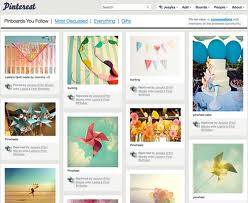
Turns out Pinterest is a collection of virtual pin boards, social-networked. The official explanation:

What is Pinterest?
Think of Pinterest as a virtual pinboard — a place where you can create collections of things you love and “follow” collections created by people with great taste.
People use Pinterest to collect and share all sorts of things — wedding inspiration, favorite T-shirts, DJ equipment. You name it, people are pinning it.
We know you have great taste in something. Our mission is to make Pinterest the best place for you to share your taste with the world.
It feels kind of like fantasy football but for stuff. Sure, it’s inspiring, but looking at other people’s boards starts to make me feel a little tight-chested, like I am never going to have enough disposable income/time to make my home/wardrobe/travel plans/food look even 1/8 as good as the stuff on Pinterest. I turn away from the screen and see my haphazard, design-aesthetic-lacking furniture and the jar of Old El Paso in my fridge and stretched-out cardigans from Old Navy and feel like a wee bit of a failure at life.
But–I’ve found one awesome way to use Pinterest for my writing. I’ve always tried to make character collages to get a sense of the gestalt of my characters. Handmade, IRL collages are not the easiest to put together; you need a lot of magazines, glue sticks, and time. It’s also easier said than done to find the right images for your characters/settings/whatever you’re making the collage for. Not so with a virtual pin board. I can create a new board for a character or scene, then run all over the Internet snagging related images. Maybe I find a house that looks like the spooky one a character is renting. Then maybe I find an image of the food she’s cooking, the dress she’s wearing, the musician whose album she’s playing when the ghost first appears. When I sit down to write the scene later, all my inspiration is right there on Pinterest if I need it.
I’m not sure yet how much I’ll use Pinterest as a writing tool–for one thing, pin boards are public and I like to write with the door closed. It’s a cool option to have, though.

Archives