books

Bookanista Rec: Wonder

It’s time for another Bookanista recommendation: R. J. Palacio’s Wonder.

Here’s the summary from Goodreads:

August (Auggie) Pullman
was born with a facial deformity that prevented him from going to a
mainstream school—until now. He’s about to start 5th grade at Beecher
Prep, and if you’ve ever been the new kid then you know how hard that
can be. The thing is Auggie’s just an ordinary kid, with an
extraordinary face. But can he convince his new classmates that he’s
just like them, despite appearances?

R. J. Palacio has written a
spare, warm, uplifting story that will have readers laughing one minute
and wiping away tears the next. With wonderfully realistic family
interactions (flawed, but loving), lively school scenes, and short
chapters, Wonder is accessible to readers of all levels.

I have to admit that I put off reading Wonder, even though I’d heard such wonderful things about it. I worried that it might be too painful to read about some of the things that happen to Auggie, especially if I loved his character as much as I suspected I would. I got even more
fearful that this would be a tough read when I started reading and
immediately fell in love with Auggie’s sweet MG voice. I read it in a day.


And reading Wonder was sometimes painful–set the book down, close your eyes, and take a deep breath before continuing to read painful–but that, if anything, only enhanced the reading experience. Wonder‘s central message–choose kindness–is important for readers of all ages to hear. The multiple POV structure really builds on that message by creating so much empathy for all of the characters. This is a book that contains moments of heart-crushing sadness and disappointment, but many more of uplifting love and courage.

See what my fellow Bookanistas are recommending today:


Shari Arnold has chills for BY BLOOD, by Tracy E. Banghart
Christine Fonseca has all the feels for DARKEST MERCY, by Melissa Marr
Nikki Katz is gushing about BLYTHEWOOD, by Carol Goodman
Stasia Ward Kehoe has taken a shine to GOLDEN, by Jessi Kirby
Jessica Love has fond memories of ALL OUR YESTERDAYS, by Cristin Terrill

Lenore Appelhans swoons for THESE BROKEN STARS by Amie Kaufman & Meagan Spooner

MMGM: Keeping Safe the Stars

One of my favorite reads of 2011 was Sheila O’Connor’s Sparrow Road. A midwest setting, a creepy mansion/artist’s colony, and mysteries–what more could you want? (Not to mention beautiful prose and compelling characters.) So I was very excited to read the author’s next book, Keeping Safe the Stars. Here’s a summary from Goodreads:

Such a gorgeous cover

When crisis hits, a young girl becomes the only one left to take care of her family

Pride,
Nightingale and Baby are the Stars. Orphaned and living with their
grandfather, Old Finn, in rural Minnesota, the children, like their
grandfather, are wary of outsiders. They believe, as Old Finn taught
them, in self-reliance.

But then Old Finn falls seriously ill and
is taken to the hospital all the way in Duluth, leaving the children to
fend for themselves. Pride, as oldest, assumes the lead. Though she
makes mistakes, she keeps them afloat; they even earn money for the bus
trip to Duluth. But when they finally see Old Finn, he can’t walk or
even say his own name, and Pride knows her days of keeping safe the
Stars are drawing to a close. Self-reliance can’t make Old Finn well
again. But maybe, just maybe, a secret from Old Finn’s past might make a
way for them to stay together after all.

In a review somewhere (possibly on Goodreads), Keeping Safe the Stars was compared to the Boxcar Children series. The resilience and love in the Star family did remind me of that beloved series (not just the plot element of kids fending for themselves). This story is set in the Watergate era, and it was so interesting to step back into a relatively recent time when kids were encouraged to be independent in their home/community–I’m not necessarily saying it’s good or bad that middle-graders rarely roam free on country roads today; things are just different.

This book is full of strength and grit and community, and it has a love story, too. I really adored it.
I’m not alone in my feelings for Keeping Safe the Stars; it recently won the Midwest Bookseller’s Choice award for Children’s Literature.

To see what other marvelous middle-grade books readers and writers are blogging about today, check out Shannon Whitney Messenger’s blog for the MMGM links!

MMGM: Every Day After

One of the many fun things about being part of OneFour KidLit is getting to interview debut 2013 authors about their great new books. Tomorrow, my interview with Laura Golden, author of Every Day After, will be up on the OneFour blog. But I couldn’t wait until then to post about this historical MG gem. Here’s a little about the book, from Goodreads:

Trouble has rained down
on Lizzie Hawkins. Her daddy has deserted the family, her mama is
silent with sadness, and the bank is after their house.
Daddy
always said Lizzie was born to succeed, but right now she can’t even
hold on to her top grades or her best friend, Ben. Bratty newcomer Erin
Sawyer has weaseled both away from Lizzie, but Erin won’t be satisfied
until Lizzie is out of her hair for good, packed off straight to the
nearest orphanage.

Still, Lizzie refuses to lose what’s left of
her family. With the bank deadline fast approaching, Erin causing strife
at every turn, and Mama and Ben slipping away from her, Lizzie finds
comfort writing in her journal and looking at Daddy’s face in the
heirloom locket he left her. She’s keeping her head high and holding
onto hope that Daddy returns on her twelfth birthday. Still, she can’t
help wondering: Why did Daddy have to leave? And can I save us if he
doesn’t come home?

Times may be tough in Bittersweet, Alabama,
but the unsinkable Lizzie Hawkins will inspire readers with her
resilience and determination.

Laura kindly lent an ARC to me so I could read Every Day After in advance of our interview–although I plan to buy a copy once it hits shelves, because this is one of those marvelous MG books that will be an instant classic. The character development is rich, the setting is so real that you start to feel like you have GooGoo Clusters stuck in your teeth (a candy that Lizzie longs for in the book), and the themes and message are timeless. It really struck me, while reading, how relevant a story about a young girl staying strong in the face of economic troubles is today. Lizzie’s determination and strength are a model to anyone, of any age, who is struggling.
But this is also a great MG story about community, friendship, and finding yourself, one with plenty of sweet humor. I highly recommend that tomorrow, you pick up a copy of Every Day After.

To see what other marvelous middle-grade books readers and writers are blogging about today, check out Shannon Whitney Messenger’s blog for the MMGM links!

MMGM: Will Sparrow’s Road

As a reader, I have a strong pull toward girl heroines–if I were to break down the kid lit I read, probably 92% has a female MC or narrator. Also as a writer, I generally find inspiration in girl POVs. So I’ve been meaning to pick up more books that have boy voices. I’ve always loved reading Karen Cushman’s strong and interesting girl
protagonists, as well as her intricately researched historical fiction, so I was excited to read her first book with a male main
character: Will Sparrow’s Road.

“I care for no one but myself, and nothing but my belly,” says Will
Sparrow, the itinerant hero. He’s a tween boy making his way, alone, along a road and through the vibrant and sometimes dangerous world of 16th-century England. Will has good reason to care for his belly–he’s hungry and has to rely on cleverness and the occasional thievery for food. A plot summary from the Goodreads page:

In his thirteenth year, Will Sparrow, liar and thief, becomes a runaway. On the road, he encounters a series of con artists—a pickpocket, a tooth puller, a pig trainer, a conjurer—and learns that others are more adept than he at lying and thieving. Then he reluctantly joins a traveling troupe of “oddities,” including a dwarf and a cat-faced girl, holding himself apart from the “monsters” and resolving to be on guard against further deceptions. At last Will is forced to understand that appearances are misleading and that  he has been his own worst deceiver. The rowdy world of market fairs in Elizabethan England is the colorful backdrop for Newbery medalist Cushman’s new comic masterpiece.

I really loved how this book worked as a classic picaresque (Comp Lit Nerd Alert, I know), in that Will had to live by his wits to survive in a somewhat harsh world–sometimes to comic effect. The plot had a great balance of being episodic (neat little scenes in which Will has a struggle, or does something clever; characters who flow in and out in a way consistent with Will’s chaotic life and the time period) and having a rewarding character arc. I also loved how, in true picaresque style, Cushman didn’t pull her punches in terms of the difficulties all people–including children–experienced during that time. The stakes were high for Will, and it made his successes that much more rewarding.

To see what other marvelous middle-grade books readers and writers are blogging about today, check out Shannon Whitney Messenger’s blog for the MMGM links!

On Moving and Books

I’m currently packing up my apartment. In the process, I’ve determined that books comprise about 40% of what I own. (Sorry, robbers. If you don’t want paperbacks or old T-shirts or shoes with an odd wear pattern because apparently I walk funny–you’re out of luck.) Right now they are strewn across the floor of our living room/office/storage area/guest room (life in small spaces, yo) and slowly making their way into poorly packed boxes.

A poorly packed box.

I think books might actually be the Very Worst Thing to Pack. Worse than glassware. Hear me out: books are heavy, they come in wildly variant trim sizes, and they are dusty (at least if they belong to someone who hates dusting, like me). Putting them into boxes feels like the world’s most frustrating game of Tetris. There’s always ONE art book that is super long and won’t fit in the box and screws everything up, so another box full of tcotchkes that normally could live in the back of a closet in the new place (never to be unpacked–almost as good as actually dealing with the clutter) now contains a book and therefore has to get unpacked and dealt with.

Anyway. Can you tell that I’m at the point of moving at which I wish someone would hit me over the head with one of my rarely used kitchen appliances, or the copy of Benet’s Reader’s Encyclopedia that I haven’t opened since college, and I could wake up once we’re settled again?

I love print books. Always have, probably always will. Given the choice, I will opt to read in print form as opposed to on my iPad. But damn it if moving doesn’t make me want to bring my entire collection to the Strand and go digital. To think I could have every book in the mountain of brown boxes that currently prevents me from walking from my desk to the closet door on my 0.68-pound tablet . . .

What about you? Does moving (or dealing with piles of books in your home on a regular basis) make you want to convert to e-reading?

MMGM: Sway

I’m really excited to join in the Marvelous Middle-Grade Monday fun, hosted every Monday by Shannon Messenger. Today I want to talk about Amber McRee Turner’s fantastic debut, Sway.

From the publisher (Disney*Hyperion):

For four long months,
ten-year-old Cass has been dreaming of the day her mom, Toodi, will come
home. But when Toodi’s welcome back party takes a turn for the
disastrous, Cass finds herself stuck alone with her dull-as-dirt dad,
who insists that they set off for the summer on a mysterious
adventure—just the two of them.


It turns out Cass’s dad has some
big-time surprises up his sleeve. Once they hit the road in an old RV
named The Roast, he introduces her to the amazing power of “Sway,” a
seemingly magical force that can bring inspiration and joy to people in
major need of help.


Adorable cover!
Cass can think of one particular person who could really use some Sway. If only she could track down Toodi, Cass knows
she could convince her mom to come home. But with the help of a little
home-spun magic, Cass realizes that the things she needs most have
always been within her reach.

Way back when I was a middle-grader, I read Sharon Creech’s Walk Two Moons, and I think part of me has been trying to recapture that reading experience ever since. Reading Sway, I finally did. Like Walk Two Moons, Sway is about a journey, both emotional and literal, in search of a mom and in search of something to believe in.

But I don’t mean to simply gush about Sway in terms of some similarities to one of my favorite books from my childhood. I loved Amber McRee’s limber use of language (reading this book, you’ll want to stop and read lines aloud to fully appreciate the wordplay), her richly drawn characters, and the playful humor that compliments the occasionally heartstrings-tugging plot. As someone who loves to read and write historical fiction, I loved the tidbits about historical figures worked into the story, too.

I can’t pick up a sliver of soap now without smiling and thinking of Cass.

What I read in 2012

State of Wonder ~ Revolution ~ The Fault in Our Stars ~ The
Disenchantments ~ The Handmaid’s Tale ~ True Grit ~ Love? Maybe ~ The
Future of Us ~ Rebecca ~ The Snow Child ~ All These Lives ~ The
Thirteenth Tale ~ Hemlock ~ Enchanted Ivy ~ A Young Wife ~ The Guernsey
Literary & Potato Peel Pie Society ~ Wanderlove ~ The Art of
Fielding ~ The Espressologist ~ Dear American Airlines ~ American Born
Chinese ~ The Book Thief ~ Promise the Night ~ Amelia Anne is Dead and
Gone ~ The Time it Snowed in Puerto Rico ~ The Wilding ~ Jellicoe Road ~
Insurgent ~ The Unbecoming of Mara Dyer ~ How Should a Person Be? ~
Laura Rider’s Masterpiece ~ Audrey, Wait! ~ Skinny ~ So Much Closer ~
Monstrous Beauty ~ The Conscious Bride ~ Moloka’i ~ The Bungalow ~ MWF
Seeking BFF ~ Between Shades of Gray ~ Prairie Evers ~ Laura Lamont’s
Life in Pictures ~ Liar & Spy ~ Roanoke: The Abandoned Colony ~ Gone
Girl ~ Mark Twain in Hawaii: Roughing It in the Sandwich Islands ~
Roanoke: Solving the Mystery of the Lost Colony ~ The Butterfly Clues ~
The Age of Miracles ~ Beautiful Ruins ~ Life As We Knew It ~ The Raven
Boys ~ The Sinister Sweetness of Splendid Academy ~ Samantha Sutton and
the Labyrinth of Lies ~ Frost ~ Ask the Passengers ~ Rules of Civility ~
My Very UnFairytale Life ~ Catching Jordan ~ The Year We Left Home ~
Real Mermaids Don’t Wear Toe Rings ~ Mira’s Diary: Lost in Paris ~
Aristotle and Dante Discover the Secrets of Universe

That’s 62 books!
27 were YA, and 8 MG. I think 17 of those were 2012 releases.

How did I do on some of my reading goals?

1. Read more books than in 2011: Achieved! I read 52 books in 2011.

2. Catch up on classics: Not much progress here, although I did finally read Rebecca, and I read some obscure Mark Twain.

3. Read some YA Nonfiction: I did! I read The Pregnancy Project.

4. More genres: I read fewer scifi/fantasy books than in 2011, but more thrillers and more historical fiction.

5. Reread old favorites: Total fail. I didn’t reread anything. Can you blame me, though, when there are so many wonderful books to read?

This year, I want to keep up my book-a-week pace, read more debuts, and even out my MG-YA reading ratio.

Guest Post: MG Author Jordan Jacobs

Today I’m excited to host Jordan Jacobs, author of the MG mystery Samantha Sutton and the Labyrinth of Lies, for a guest post. Samantha Sutton features a whipsmart and adventurous heroine, a realistic sibling relationship, lots of action and adventure, and loads of very cool archeology factoids. Jordan Jacobs really does have my childhood dream job: an archaeologist who write novels on the side. When he’s not writing the Samantha Sutton series, what is his archaeology work like? I pictured something straight out of the Indiana Jones ride at Disneyland. Read on to find out what an archaeologist really does.


Just Another Day at the Office
Jordan Jacobs

The movies don’t get everything wrong when it comes to archaeology. Even in real life, there’s plenty of adventure to be found.

As an archaeologist, I’ve gotten to work high in the Andes at Chavin de Huantar—crawling through unexplored tunnels full of bats and rubble and scattered human bones. I’ve excavated Crustumerium, just north of Rome, where Bronze Age peoples lie at rest in a sprawling city of the dead. I’ve worked in the United States as well, clearing cemeteries in advance of major construction projects, excavating cliff dwellings, and digging the toilet of a California governor from the wreckage of his earthquake-totalled mansion.

But of course, this sort of adventure is only part of the job.

An archaeologist’s task is to study past cultures through what they’ve left behind. These pieces of evidence—or “artifacts”—can be as big as an Egyptian pyramid or as small as a speck of pollen, stuck to an ancient cooking pot. But the information they contain can be surprising. Archaeologists can use these artifacts to reconstruct how people once lived—from the food they ate, to the way they fought, to the religions that they practiced and their views of the world around them.

The archaeologist’s “typical day” takes a variety of forms. Some work mostly in the field–surveying the land, digging precise excavation units into the earth, looking for patterns, making comparisons, and drawing careful conclusions from whatever pieces of the past still remain. Others work in laboratories, using the tools of science to discover how old an object is, exactly what it’s made of, or precisely where it came from. Still others spend their days in museum storerooms, re-examining the evidence recovered by their predecessors. And some archaeologists work with governments and companies in order to protect sites from destruction through development, looting, neglect, or war.

But archaeology also carries a lot of responsibility. One awkward truth is that excavation destroys sites, meaning that each particular discovery can be made only once. It’s up to the archaeologist to record everything he or she can–otherwise, that information is lost forever. Just as importantly, archaeologists have a responsibility to the people who live nearby the site, or who claim it as their ancestors’.

At its best, archaeology is a little like time travel. Holding an artifact in your hand can make you feel a connection to someone who lived centuries or millennia before. It’s intimate. It’s humbling. Seeing the fingerprint of a potter on the surface of a plain and broken pot is a reminder of the humanity all people share–no matter where, or when, we live.

*Full disclosure: I share a publisher, Sourcebooks Jabberwocky, with Jordan Jacobs. I purchased my own copy of Samantha Sutton, however, and any opinions are my own.*

Miss Teen Dream Fun Facts Page!

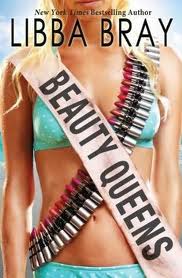
I had so much fun reading Libba Bray’s Beauty Queens. So much fun that I didn’t want to write a review or even sum up my thoughts on the madcap, hilarious satire. Instead, here’s my homage to that perfect end-of-summer read: my own contestant fun facts page, if as a Wisconsin teen I hadn’t been more Daria-like than a Teen Dreamer.

Name: Rebecca Behrens
State: Miss Wisconsin
Age: 16
Height: almost 5′ 3”
Weight: Depends on how many dairy products I have sampled
Hair: Brown
Eyes: Green
Best feature: Arm muscles from frozen-custard scooping

Fun Facts About Me:

I secretly love to sing along to my Boyz Will B Boyz CD while dancing around my room. But in public, I tell everyone I only listen to alternative and folk rock.*
My favorite show is NOVA Captains Bodacious.
The thing that scares me most is Ladybird Hope the swimsuit competition running out of the Corporation’s 100 Lashes mascara.
I love watching old movies, and I like to make Hitchcock blonde Halloween costumes.
My dream is to run the Corporation’s doughnut production business unit. Or to be an investigative journalist who exposes crooks with hidden cameras. I love me some hidden cameras.

*The Corporation suggested that I do not mention Ani DiFranco by name.

For those of you who’ve read
Beauty Queens: what would your fun facts be?

Little Free Libraries!

I’m in love with Little Free Libraries–a grassroots effort to promote literacy and community. I’m also proud that it’s from my home state (and that my hometown is the one place where you can pop in a shop and buy a prefab Little Free Library).

Little Free Library #1 (Source)

The Little Free Library mission:

To promote literacy and the love of reading by building free book exchanges worldwide.
To build a sense of community as we share skills, creativity and wisdom across generations.
To build more than 2,510 libraries around the world–more than Andrew Carnegie!

Little Free Library next to my
 favorite Madison coffeeshop! (Source)

For more info, or to become a Little Free Librarian, check our their website: Little Free Library

Bossypants (and its therapeutic effects)

You might know that I am a fearful flier; in fact, you probably know it because one of the ways I “deal” with my fear is by blabbing to everyone I come into contact with about how freaked out I get about planes. Before a flight, I might talk about my phobia to: my super, my cubemates, my parents, my grandma, my fiance, the checkout lady at Duane Reade, all cab drivers I come into contact with, strangers on the Interwebs, the barista, strangers on the Air Train, my seatmate, etc. Most people are nice and try to reassure me by saying one of these three things:
–I fly all the time! And nothing has ever happened to me. (There is a first time for everything, buddy.)
–Air travel is the safest mode of transportation. (I bet they said that about the Hindenburg. And the Titanic.)
–You have a better chance of getting killed in a car accident on the way to/from the airport than on the plane. (This one makes no sense to me. I mean, we just established that I am a worrier. Are you trying to give me more fears? In NYC, people often like to tell me that I have better odds of getting smushed to death by a falling window-unit air conditioner. Well, congratulations: I’m now afraid of air conditioners, too.)

Despite all that reassurance, I still white-knuckle my way through a hell of a lot of flights. No what matter shiny object you put in front of my face, I can’t stop thinking OMG I AM WAY UP IN THE AIR IN A METAL TUBE WHAT’S THAT NOISE I HOPE NOBODY LOOKS AT MY GOOGLE SEARCH HISTORY AFTER I DIE.

Correction, there is one shiny object that will actually distract me and make me relax. It is this:

Yes, I read Bossypants on my flight and it was so awesome that I actually enjoyed myself. Instead of crying annoyingly next to my businessman seatmate, I was laughing annoyingly. Hysterically, the whole time. I even bonded with the flight attendant about it. We giggled together.
Tina Fey is my hero. She nailed every single word in Bossypants, the most consistently hilarious book of essays I’ve read (other than a Sedaris book). There’s even an essay that deals with a fear of flying (not hers), which I read at 36,000 feet. It was meta.
Writing this post, I kept rereading parts of the book and wanting to transcribe bits to show you how amazing and super-funny it is. But then I realized that I would end up posting the entire freaking thing, because it’s all so good, and that would probably violate copyright law. So I will say: judge this book by its cover. Which is awesome. Like the contents.

How a Book Used to Be Made

The Westing Game was my favorite books from fifth grade to–well, it’s still a favorite. If you haven’t read it, please go find a copy because it’s an amazing read.

I was perusing the [Cooperative Children’s Book Center] CCBC’s site today and unexpectedly discovered that they have an online archive of the manuscript of The Westing Game. Author Ellen Raskin donated her manuscript materials and provided audio and written commentary in 1978, around the time the book was published by Dutton. Her goal was to inspire those who used CCBC’s services, because she “often remarked during her career that she wished she had known ‘where children’s books come from’ while she was a young UW-Madison art student.”

I think this archive is really, really cool even if you don’t adore The Westing Game. The process Raskin describes for book production is very, very different from how it’s done today, so it’s a kick to see how publishing used to work. There are scores of her handwritten notes, outlines and planning (such as her notes on potential titles), research materials (such as a letter about Wisconsin Judges), marked-up drafts, and even her book cover designs. If you have any interest in manuscript history/the history of publishing, check it out! If you don’t care about book production, you still might be inspired by some of her methods for the writing process.

Archives