nerdiness

Women’s History Wednesday #1: Bessie Coleman

I love March for a few reasons: daylight savings time begins, theoretically it stops being so cold, the Chicago River gets dyed green, and the official start of SPRING! But I especially love that March is Women’s History Month and we get to spend 31 days celebrating daring, genius, funny, complicated, important, strong, wise ladies. One of my favorite things about writing historical fiction is getting to explore the lives of real, and sometimes famous, women—like Alice Roosevelt. When Audrey Met Alice allowed me to spend a lot of time researching the women who have made 1600 Pennsylvania a home in addition to a historic site. (Check out the Resources page of my website for more information on my research, along with a Women’s History Month lesson plan.) But this month, I wanted to devote some words to other female historical figures I find inspiring.

Each Wednesday this March, I’ll share a short post about a fascinating woman in honor of Women’s History Month. I’d love to hear which women interest and inspire you–please tell me in the comments! I’ll (randomly) choose one commenter on each post to win a preorder of the new When Audrey Met Alice paperback. Tweet about the women who inspire you with the hashtag #WomensHistWednesday for an extra entry.

Inspiring me today is: Bessie Coleman 
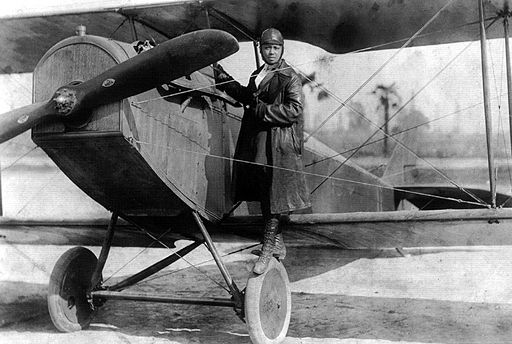
Source

Bessie Coleman and her plane in 1922 (Source)

Maybe you’ve noticed, while heading in or out of O’Hare airport, that you get to the terminals via Bessie Coleman Drive? It’s a fitting tribute to the former Chicagoan, who was the first African American woman to get a pilot’s license. While Bessie worked as a manicurist in Chicago during World War I, she listened to airmen tell stories about their flights, and it piqued her interest so much that she began to study aviation. At the time, no flying schools in the United States would admit an African American woman—so Bessie first attended the Berlitz school in the Loop to learn French, then moved to France. There she learned to fly in just seven months and earned an international pilot’s license in 1921. Upon returning to the United States, Bessie earned a living doing aerial tricks and stunts across the country. She hoped to make enough money to start a school for African American pilots. Tragically, she died at age thirty-four in an airplane accident–but her legacy lives on.

Learn more about Bessie:

PBS: American Experience: Fly Girls | Bessie Coleman

The Ninety-Nines, Inc.: Women in Aviation History | Bessie Coleman

Smithsonian video: Bessie Coleman

Fly High!: The Story of Bessie Coleman by Louise Borden and Mary Kay Kroeger

Which women inspire you?

MMGM: Will Sparrow’s Road

As a reader, I have a strong pull toward girl heroines–if I were to break down the kid lit I read, probably 92% has a female MC or narrator. Also as a writer, I generally find inspiration in girl POVs. So I’ve been meaning to pick up more books that have boy voices. I’ve always loved reading Karen Cushman’s strong and interesting girl
protagonists, as well as her intricately researched historical fiction, so I was excited to read her first book with a male main
character: Will Sparrow’s Road.

“I care for no one but myself, and nothing but my belly,” says Will
Sparrow, the itinerant hero. He’s a tween boy making his way, alone, along a road and through the vibrant and sometimes dangerous world of 16th-century England. Will has good reason to care for his belly–he’s hungry and has to rely on cleverness and the occasional thievery for food. A plot summary from the Goodreads page:

In his thirteenth year, Will Sparrow, liar and thief, becomes a runaway. On the road, he encounters a series of con artists—a pickpocket, a tooth puller, a pig trainer, a conjurer—and learns that others are more adept than he at lying and thieving. Then he reluctantly joins a traveling troupe of “oddities,” including a dwarf and a cat-faced girl, holding himself apart from the “monsters” and resolving to be on guard against further deceptions. At last Will is forced to understand that appearances are misleading and that  he has been his own worst deceiver. The rowdy world of market fairs in Elizabethan England is the colorful backdrop for Newbery medalist Cushman’s new comic masterpiece.

I really loved how this book worked as a classic picaresque (Comp Lit Nerd Alert, I know), in that Will had to live by his wits to survive in a somewhat harsh world–sometimes to comic effect. The plot had a great balance of being episodic (neat little scenes in which Will has a struggle, or does something clever; characters who flow in and out in a way consistent with Will’s chaotic life and the time period) and having a rewarding character arc. I also loved how, in true picaresque style, Cushman didn’t pull her punches in terms of the difficulties all people–including children–experienced during that time. The stakes were high for Will, and it made his successes that much more rewarding.

To see what other marvelous middle-grade books readers and writers are blogging about today, check out Shannon Whitney Messenger’s blog for the MMGM links!

Revise like an Improviser

Over the years I’ve gotten to learn a little bit about sketch comedy and improv because my husband is a long-time performer. I’m always amazed when I watch his shows at how the spontaneous collaboration works. Whenever someone onstage gets an idea rolling, the other performers embrace and expand it, and more often than not a pretty coherent story blossoms out of something as small as a single word. Considering that as many as half-dozen people are creating the story without actually negotiating the content, that’s impressive. I mean, I sometimes fight too much with myself to get anything on the page.

“Always say yes” is a rule in improv, and it’s a big part of what makes this creativity and collaboration possible. (Tina Fey talked about it in Bossypants and explains how saying yes changed her life here.) At its most basic, the idea applies to how you respond to the other performers within a scene. If you start with the intention that your scene is set in Antarctica, it’s your collaborator’s job to say yes to that idea. Not to think, No–we’re not in Antarctica; we’re at the mall on Black Friday. My idea is better; I’m changing this. No matter how wacked out the idea is, just go with it.

It’s even better to say “Yes, and . . . ” Build on ideas. So your partner places you in a scene in Antarctica, and you respond with “Yes, and we’re here because the plane crashed and now we’re stranded like the guys in the movie Alive.” And your partner might respond with, “Yes, and we would consider cannibalism to survive except we’re part of a group traveling home from a veganism conference.” And so on.

If someone refuses to say yes, things shut down. If someone doesn’t say “yes, and,” it doesn’t build. The same is true for revising.

Whenever you’re revising, and particularly when your revision involves the collaboration of someone else–like a CP, or an agent, or an editor–it’s good to keep an open mind. Approach the work with the mindset of saying yes, and–not with a mindset of no, because. Of course, this is easier said than done–nobody wants to kill his or her darlings, and a lot of times saying no is a reaction to that desire to retain and protect what we’ve worked so hard to create. Saying yes doesn’t mean blindly accepting suggestions, but pushing back out of instinct, or the need to control, instead of for a good reason can be limiting. Adding the “and” can be a way to make sure you take suggestions in a direction that’s right for you. Saying yes, and keeping yourself open to fresh ideas and collaboration, is a way to grow as a writer and a storyteller–and a way to make the revision process more creative.

So, writer friends: do you have a hard time saying yes to changes during revisions? How do you collaborate in the writing process?

Best of Blog Spam

I switched the settings for comments a while back, mainly so people could link to their URLs in their names. It was a good tweak to make, but it has resulted in an impressive influx of comment spam. Whatever, Blogger generally does a good job of weeding out spam comments automatically, so I’m not going to change back to the “registered users only” setting.

The only annoying part is getting all the notification emails about faux comments, typically from “Anonymous.” Usually Anonymous is trying to get me to visit web sites about tribal tattoos, which is kind of random, or treat acne, which sadly is already a routine part of my post-teenage life. However, reading the comments has taught me a lot about a bot’s strange grasp of grammar and syntax. Behold, some of my favorite spam comments, with their original weird formatting, along with my imagined replies:

The entire glance of your web site is fantastic, as neatly as the content!  
I appreciate that you took the time for an entire glance.

I wish to read more things approximately it!  I hope to provide more things approximately it!

That is very attention-grabbing, You are an overly professional blogger.
I’ve
joined your feed and sit up for in the hunt for more of your
magnificent post. Additionally, I’ve shared your web site in my social
networks. 
That’s me: a true overly professional.

It’s amazing to go to see this website and reading the views of all
friends regarding this post, while I am also zealous of getting
know-how.
It’s a good thing to be zealous of getting know-how.

An impressive share! I have just forwarded this onto a coworker who
was conducting a little homework on this. And he actually bought me dinner simply because
I found it for him… lol. So allow me to reword this.
… Thanks for the meal!! But yeah, thanx for spending time to discuss this matter here on your web site.
Hey, any time a post gets a reader free dinner is a win, as far as I’m concerned.

Hi to every one, the contents existing at this website
are actually amazing for people knowledge, well, keep up the nice
work fellows.
The “fellows” and I thank you, and are happy to provide “people knowledge.” As opposed to robot knowledge, I guess.

Its like you read my mind! You appear to know a lot about this, like you wrote the book in it or something.
I think that you could do with a few pics to drive the message
home a little bit, but instead of that, this is excellent blog.
A great read. I’ll definitely be back.
Thanks for the unsolicited advice. I’m glad that despite the lack of pics, you will definitely be back. (Ironically this was on a post about the White House, and I did sort of write a “book in it.”)

Fortunate me I found your website accidentally, and I am stunned why this twist of
fate did not took place earlier! I bookmarked it.
I am also stunned why this twist of fate did not take place earlier for fortunate you!

bear grylls bear grylls bear grylls Dude: anyone who knows me knows that I watch I Shouldn’t Be Alive, not the Bear Grylls show.

On First Daughters and Fandom

Kennedy Family at Camp David (source: Wikimedia Commons)

It’s not surprising that I wound up writing a story about a pair of first daughters; I am a First Kid superfan. My interest in children in the White House has been lifelong–I remember seeing old photographs of the Kennedy children in the Oval Office when I was a kid and being fascinated by them. Same for ones of Amy Carter. Chelsea Clinton is not much older than me, and when President Clinton was in office, I soaked up every tidbit I could (harder to do, in the pre-Internet era) about her tweenage life at 1600.

I also have strong memories of some of the media scrutiny Chelsea faced as a first daughter. There were SNL skits that meanly mocked her, and snide comments from journalists like this tone deaf essay from Frank Rich at the NYT, “The Chelsea Show.” Yes, a grown man publicly called out her “gawkiness, frizzy hair, and orthodontically transitional smile.” It appears he was trying to be sympathetic to Chelsea’s plight in his “humorous” essay, but dude: what an ass.

Margaret Truman Daniel, a former first daughter herself, wrote a famous Letter to the Editor to chastise him. It was part of the reason why the media generally stopped reporting on the children of presidents. (The NYT describes that as an “informal pact” between the press and the White House in their article on how Malia Obama’s spring break trip almost became news. It clarifies that unless the girls are with their parents, they are considered off-limits by much of the media.)

I’ve had a lot of impulses over the past couple of years to blog about the Obama girls, for obvious reasons (they are first kids, and they also seem like very cool kids). I’ve tried to hold back. The thing is, it’s a different situation to write about historical first daughters (those that are now deceased), former first daughters (those who are now adults), and the current two. It’s clear that the information released about the Obama girls is closely guarded, as it should be. Administration officials must work very hard to protect a little privacy for the first family, and that is an admirable thing. Perpetuating public interest in the Obama girls–even simply through linking to photos or articles on other sites on my humble blog–doesn’t seem fair. The smidge of privacy they maintain has been hard-won, and it’s important to respect that.

I hope to start sharing more of the information I’ve learned about life at the White House and famous first kids over the next TK-many months until When Audrey Met Alice comes out. Only the fun stuff, though–I promise not to bore you! But one thing you won’t read about here are the current occupants of 1600 Pennsylvania Avenue, unless it’s a link to or sourced by some kind of official information.

What do you find interesting about First Kids*?

*A nerdy little grammar note: So far as I can tell, it is not grammatically correct to capitalize unofficial titles such as first daughter and first kid. Even First Lady is not an official title, although it is commonly treated as such and therefore capitalization is accepted. Sometimes I do capitalize first daughter or first kid, though, as a stylistic choice to highlight the title. The copy editor part of me is annoyed by this. I should probably start being consistent.

The Next Big Thing

Thanks to Katy Upperman for tagging me. I loved reading about her fabulous WIP, Cross My Heart. Here are some answers about my upper-MG WIP:

What is the working title of your book?
When Audrey Met Alice

Where did the idea come from?
It’s kind of a long story. I knew a little about Alice Roosevelt from my dad, who has always been a huge Teddy Roosevelt fan. I have always been fascinated by the lives of first daughters, and I suppose that interest was re-sparked when the Obamas moved into the White House.

But the specific idea for a book about a first daughter who “meets” Alice Roosevelt came to me while I was walking home from work one day. That’s not very special, but I later found out that I was walking past a home where Alice once lived, as a young person, right at the time that this concept popped into my head. Which is a little spooky.

What genre does your book fall under?
A blend of contemporary and historical fiction

Which actors would you choose to play your characters in a movie rendition?

Alice Lee Roosevelt (from Wikipedia.org)

I am a huge Mad Men fan, and one of my favorite characters is Sally Draper. I would love to see the very talented Kiernan Shipka as Audrey. As for Alice, I’m not sure. Any suggestions?

What is the one-sentence synopsis of your book?
Lonely first daughter finds Alice Roosevelt’s long-lost diary, and shenanigans ensue.

Will your book be self-published or represented by an agency?
I am so fortunate to be represented by the amazing Suzie Townsend at New Leaf Literary.


How long did it take you to write the first draft of your manuscript?
Hmm, I got the idea in summer 2010, and I had a finished first draft by the end of that year. I wasn’t working on it continuously, though: there were some distracting life events (e.g., a move) and some revisions on a previous manuscript that pulled me away at times. So I’d say about five months. But that was a first draft of two completely separate narratives, which I had to try to weave together.

May we see an intro?
I’ll give you the first line:
It is ridiculously difficult to
get a pizza delivered to 1600 Pennsylvania Avenue.

What other books would you compare this story to?
In some ways, the structure is similar to Revolution, which I read long after the first draft. But my manuscript is upper middle grade, so the subject matter is a little lighter. Promise the Night, an MG about famous female aviator Beryl Markham, is also kind of similar. I like to think that both Audrey and Alice have strong voices, and there is a lot of humor in the stories they tell. So I might compare it to some of my favorite voice-driven books.

Who or what inspired you to write this book?
Alice Roosevelt, of course. She was a scandalous White House wild child at a time when girls had a lot of social constraints. Also, there was a photograph of Sasha Obama on a beach that I found really poignant–she’s in her swimsuit, playing in the sand. But you can see behind her a horde of people gawking at her and taking pictures. First kids are afforded some incredible opportunities and experiences, but I imagine they also lose a lot of privacy, freedom, and normalcy. I wanted to explore that situation.

What else about your book might pique the reader’s interest?
There is a very cute boy. And lots of descriptions of food.

Have you shared about your WIP? If you’d like to, consider yourself tagged for the Next Big Thing!

The Hippocratic Oath for Revisions

This week I’m returning to a sh!tty first draft from a long hiatus. It’s been so long and the draft is so raw that I don’t know whether to call this an extension of drafting, rewriting, or revising. It’ll probably be all three.

I get nervous when I start a revision, for a lot of reasons but mostly because I’m afraid of making the MS worse. The phrase that pops in my head as I work is a famous one from the Hippocratic Oath, “First, do no harm.” [Oh, wait. Apparently that line was never explicitly stated in the actual oath itself.] Anyway, my manuscript is like a sick patient and I’m standing at the operating table, scalpel in hand, not totally sure what to do. All I know is that I want the story to get better, and I better not hurt it.

It makes me wish that there was a writers’ Hippocratic Oath for Revisions; something to guide the process or the way I should approach the daunting work. So I wrote one.

The Hippocratic Oath for Revisions/Rewrites
—Adapted from the Modern Hippocratic Oath, which was written in 1964 by Louis Lasagna, Academic Dean of the School of Medicine at Tufts University. The Modern Hippocratic Oath is used in many medical schools today. Full text of the oath: The Hippocratic Oath Today

I swear to fulfill, to the best of my ability and judgment, this covenant:

I will respect the hard work I already have done on this manuscript, and I will gladly view this revision (including its successes and missteps) as a learning experience for the manuscripts to follow.

I will apply, for the benefit of the sick story, all measures [that] are required to make it well, avoiding those twin traps of overcorrection and “therapeutic nihilism,” or the idea that fixing what is wrong with the story is impossible.

I will remember that there is science to writing as well as art. I will seek out craft advice as well as my own creativity. I will remember that showing warmth, sympathy, and understanding to myself, the author, may outweigh draconian work schedules or self-criticism. (Conversely, I will commit to regular and focused work on the task at hand.)

I will not be ashamed to say “I know not,” nor will I fail to call in my beta readers, CPs, and writing friends when the skills of another are needed for a manuscript’s recovery.

When making changes, I will remember this: First, do no harm. I will prevent creating new problems whenever I can, for prevention is preferable to cure. Most especially must I tread with care in matters of cutting and adding. If it is given me to save a book, all thanks. But it may also be within my power to trunk a book; this awesome responsibility must be faced with great humbleness and awareness of my own strengths and weaknesses. 

I will remember that I remain a member of the writing community, with special obligations to all my fellow writers as well as readers. I will respect the great storytelling tradition as I work. I will think of words and meaning, not sales figures and markets.

If I do not violate this oath, may I enjoy life and art, respected while I live and remembered with affection thereafter. May I always act so as to preserve the finest traditions of my calling and may I long experience the joy of writing. Even in the midst of revisions.

So, writer friends: What have I left out of the oath? Or what should be cut?

Revision Trick: Wordle

Before I started inputting my hard-copy edits Saturday, I decided to make a Wordle of my MS. (Yes, I was procrastinating.) Copying my entire 70K MS to the clipboard and pasting it into the Wordle maker almost killed my computer, which was probably EXTREMELY STUPID to do, especially because I didn’t save the file or anything beforehand. But I lucked out, my geriatric MacBook regained its footing, and I got this cool Wordle out of it:

Neat, huh? Also–educational. Notice which words are the largest? Alex, like, Emma, really, and just. Two of those refer to characters, so I would expect them to be used a lot. One of them can be used as several parts of speech–like is verb, modifier, and verbal tic/filler–but still shouldn’t be that prevalent. The MS is not a courtroom drama, so I doubt just was ever used as anything but a modifier. And really–really? I guess I really need to cut down on how really often I use really. Really.
Obviously, after several rounds of revision I’ve varied my word choice and cleaned up the prose and a lot of the interesting words I’ve used aren’t going to show up in a Wordle made from 70,000 words. Even if I only use really and like every three pages, they’d still be big. That doesn’t mean, though, that I shouldn’t try to cut their use as much as possible. Making the Wordle was a giant reminder that I need to watch for repetition and be mindful of what I can cut so the story is told more eloquently and efficiently.
Ready to revise your WIP? Try just making a Wordle, and help yourself see which words you really need to snip.

How a Book Used to Be Made

The Westing Game was my favorite books from fifth grade to–well, it’s still a favorite. If you haven’t read it, please go find a copy because it’s an amazing read.

I was perusing the [Cooperative Children’s Book Center] CCBC’s site today and unexpectedly discovered that they have an online archive of the manuscript of The Westing Game. Author Ellen Raskin donated her manuscript materials and provided audio and written commentary in 1978, around the time the book was published by Dutton. Her goal was to inspire those who used CCBC’s services, because she “often remarked during her career that she wished she had known ‘where children’s books come from’ while she was a young UW-Madison art student.”

I think this archive is really, really cool even if you don’t adore The Westing Game. The process Raskin describes for book production is very, very different from how it’s done today, so it’s a kick to see how publishing used to work. There are scores of her handwritten notes, outlines and planning (such as her notes on potential titles), research materials (such as a letter about Wisconsin Judges), marked-up drafts, and even her book cover designs. If you have any interest in manuscript history/the history of publishing, check it out! If you don’t care about book production, you still might be inspired by some of her methods for the writing process.

Archives