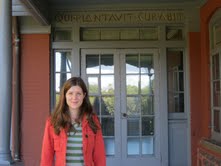
A question I get asked a lot is why I write MG. The shortest answer is: I like it. For a slightly longer but still not comprehensive answer, check out the Mad for MG feature at the OneFour Kid Lit blog today, in which all of us ’14-debut MG writers talk about why we’ve found a home in this category. Also, we have pictures. (Spoiler alert: Mine is not from when I was a middle-grader. I swear that’s not to spare myself from having photographic evidence of my awkward phase on the Internet, but just because I am old enough that all middle-school pictures of me are in albums and not on my computer.)
As a reader, I have a strong pull toward girl heroines–if I were to break down the kid lit I read, probably 92% has a female MC or narrator. Also as a writer, I generally find inspiration in girl POVs. So I’ve been meaning to pick up more books that have boy voices. I’ve always loved reading Karen Cushman’s strong and interesting girl
protagonists, as well as her intricately researched historical fiction, so I was excited to read her first book with a male main
character: Will Sparrow’s Road.
“I care for no one but myself, and nothing but my belly,” says Will
Sparrow, the itinerant hero. He’s a tween boy making his way, alone, along a road and through the vibrant and sometimes dangerous world of 16th-century England. Will has good reason to care for his belly–he’s hungry and has to rely on cleverness and the occasional thievery for food. A plot summary from the Goodreads page:
In his thirteenth year, Will Sparrow, liar and thief, becomes a runaway. On the road, he encounters a series of con artists—a pickpocket, a tooth puller, a pig trainer, a conjurer—and learns that others are more adept than he at lying and thieving. Then he reluctantly joins a traveling troupe of “oddities,” including a dwarf and a cat-faced girl, holding himself apart from the “monsters” and resolving to be on guard against further deceptions. At last Will is forced to understand that appearances are misleading and that he has been his own worst deceiver. The rowdy world of market fairs in Elizabethan England is the colorful backdrop for Newbery medalist Cushman’s new comic masterpiece.
I really loved how this book worked as a classic picaresque (Comp Lit Nerd Alert, I know), in that Will had to live by his wits to survive in a somewhat harsh world–sometimes to comic effect. The plot had a great balance of being episodic (neat little scenes in which Will has a struggle, or does something clever; characters who flow in and out in a way consistent with Will’s chaotic life and the time period) and having a rewarding character arc. I also loved how, in true picaresque style, Cushman didn’t pull her punches in terms of the difficulties all people–including children–experienced during that time. The stakes were high for Will, and it made his successes that much more rewarding.
To see what other marvelous middle-grade books readers and writers are blogging about today, check out Shannon Whitney Messenger’s blog for the MMGM links!
I really love time-travel books, and one of the things I’ve enjoyed about reading lots of them is that different authors tend to focus on distinct aspects of time travel. The Time Traveler’s Wife focuses on how it affected relationships; Stephen King’s 11/22/63 is about the greater what-ifs and how a time traveler can affect the whole world. Before I Fall was time travel-ish (in a Groundhog Day kind of way), and in it the protagonist experienced significant (and heartbreaking) personal growth through repeating time. There are lots of other examples (and if you have suggestions of other good time-travel books, let me know! I already have a copy of Time & Again waiting on my shelf, and Time Between Us is on my list of books to be bought), of course.
In the Mira’s Diary MG series, author Marissa Moss uses time travel for adventure and to educate readers: about history, art, tolerance, and some big ideas. It’s really a genius blend. Even as a non-MG reader, I feel like I know so much more about lesser-known historical figures, iconic places, and art after reading each book. The first was set in Paris, and the latest is set in Rome. From the jacket:
As if traveling to a new country in search of her missing mother weren’t difficult enough, Mira has to do it dressed as a boy. In a different century.
A new postcard from her time-traveling mother points Mira to 16th century Rome. But before she can rescue her mom, she must follow the clues left around the city to find Giordano Bruno, a famous thinker and mathematician, who discovered something so shocking that important Italian officials don’t want it revealed. All the while avoiding the Watchers–time-traveling police who want Mira back in her own time.
It’s another whirlwind adventure for Mira, and this time she is determined to bring her mother out of the past.
Back to how Mira’s Diary uses time travel to introduce some pretty cool ideas to its readers. This is one of my favorite passages in the book, coming after Mira encounters Giordano Bruno while trapped in a Roman prison:
“What I grasped was an impression of the world full of glinting lights, a million futures, a zillion possibilities, an infinite number of ways forward and back. It was all so perfectly beautiful, so incredibly ingenuous, like the way you can find math in nature–from the swirls of seashells to the spines of pinecones. When dawn streamed in the high window, I hadn’t moved at all, but I felt like I’d time-traveled in a totally different way.” (p.126)
Beautiful and really cool, right? I love how ideas are a form of time travel in the Mira books, along with the actual jumps in time Mira and her mom take while on their adventures.
The Mira books are smart, engrossing, and relatable for MG readers–and they have great spot illustrations, too. I can’t wait to see where time takes Mira next.
To see what other marvelous middle-grade books readers and writers are blogging about today, check out Shannon Whitney Messenger’s blog for the MMGM links!
Disclaimer: I am a Sourcebooks author, and Sourcebooks did provide me with a copy of Mira’s Diary: Home Sweet Rome to read. But as always, my opinions are my own!
First things first: I survived my move, and so did all of my books! Phew. Now if only I could find where I packed my shoes and my chargers in this mess . . .
Anyway, I’m excited that today is the inaugural MG Monday post for mad for Middle Grade, a group of OneFour Kid Lit-ters. On the first Monday of every month, we’re going to be blogging about all things middle grade. Today, we’re introducing ourselves by sharing our favorite MG characters. You probably won’t be surprised about mine, since I’ve posted about the book seventy-billion times before. Go here for the post:
From the publisher (Bloomsbury): After she’s hit by
lightning at a wedding, twelve-year-old Lilah Bloom develops a new
talent: she can hear dead people. Among them, there’s her
overopinionated Bubby Dora; a prissy fashion designer; and an
approval-seeking clown who livens up a séance. With Bubby Dora leading
the way, these and other sweetly imperfect ghosts haunt Lilah through
seventh grade, and help her face her one big fear: talking to—and
possibly going to the seventh-grade dance with—her crush, Andrew Finkel.
Possibly my favorite type of middle-grade book blends realistic characters, settings, and experiences with just a touch of something magical–an element beyond suspension of disbelief (like a main character who becomes world-famous for bird calls) but less than true magical realism or fantasy (like a main character who discovers she can fly). Ghosts and light paranormal often hit this imagination sweet spot–or in the case of Small Medium at Large, a lightning-strike-induced ability to hear dead people.
Small Medium at Large is sweetly funny and highly relatable (ghostly voices aside). Who wouldn’t want to imagine a world in which those who have passed surround and support us through–particularly through the trials and tribulations of the seventh grade? From the clever title to poignant interactions with a variety of ghosts to Lilah’s witty voice, this was an absolutely charming book. Now that I’m done with it, I kind of want to dust off my Ouija board. 🙂
I’m really excited to join in the Marvelous Middle-Grade Monday fun, hosted every Monday by Shannon Messenger. Today I want to talk about Amber McRee Turner’s fantastic debut, Sway.
From the publisher (Disney*Hyperion):
For four long months,
ten-year-old Cass has been dreaming of the day her mom, Toodi, will come
home. But when Toodi’s welcome back party takes a turn for the
disastrous, Cass finds herself stuck alone with her dull-as-dirt dad,
who insists that they set off for the summer on a mysterious
adventure—just the two of them.
It turns out Cass’s dad has some
big-time surprises up his sleeve. Once they hit the road in an old RV
named The Roast, he introduces her to the amazing power of “Sway,” a
seemingly magical force that can bring inspiration and joy to people in
major need of help.
Adorable cover!
Cass can think of one particular person who could really use some Sway. If only she could track down Toodi, Cass knows
she could convince her mom to come home. But with the help of a little
home-spun magic, Cass realizes that the things she needs most have
always been within her reach.
Way back when I was a middle-grader, I read Sharon Creech’s Walk Two Moons, and I think part of me has been trying to recapture that reading experience ever since. Reading Sway, I finally did. Like Walk Two Moons, Sway is about a journey, both emotional and literal, in search of a mom and in search of something to believe in.
But I don’t mean to simply gush about Sway in terms of some similarities to one of my favorite books from my childhood. I loved Amber McRee’s limber use of language (reading this book, you’ll want to stop and read lines aloud to fully appreciate the wordplay), her richly drawn characters, and the playful humor that compliments the occasionally heartstrings-tugging plot. As someone who loves to read and write historical fiction, I loved the tidbits about historical figures worked into the story, too.
I can’t pick up a sliver of soap now without smiling and thinking of Cass.
Today I’m excited to host Jordan Jacobs, author of the MG mystery Samantha Sutton and the Labyrinth of Lies, for a guest post. Samantha Sutton features a whipsmart and adventurous heroine, a realistic sibling relationship, lots of action and adventure, and loads of very cool archeology factoids. Jordan Jacobs really does have my childhood dream job: an archaeologist who write novels on the side. When he’s not writing the Samantha Sutton series, what is his archaeology work like? I pictured something straight out of the Indiana Jones ride at Disneyland. Read on to find out what an archaeologist really does.
Just Another Day at the Office
Jordan Jacobs
The movies don’t get everything wrong when it comes to archaeology. Even in real life, there’s plenty of adventure to be found.
As an archaeologist, I’ve gotten to work high in the Andes at Chavin de Huantar—crawling through unexplored tunnels full of bats and rubble and scattered human bones. I’ve excavated Crustumerium, just north of Rome, where Bronze Age peoples lie at rest in a sprawling city of the dead. I’ve worked in the United States as well, clearing cemeteries in advance of major construction projects, excavating cliff dwellings, and digging the toilet of a California governor from the wreckage of his earthquake-totalled mansion.
But of course, this sort of adventure is only part of the job.
An archaeologist’s task is to study past cultures through what they’ve left behind. These pieces of evidence—or “artifacts”—can be as big as an Egyptian pyramid or as small as a speck of pollen, stuck to an ancient cooking pot. But the information they contain can be surprising. Archaeologists can use these artifacts to reconstruct how people once lived—from the food they ate, to the way they fought, to the religions that they practiced and their views of the world around them.
The archaeologist’s “typical day” takes a variety of forms. Some work mostly in the field–surveying the land, digging precise excavation units into the earth, looking for patterns, making comparisons, and drawing careful conclusions from whatever pieces of the past still remain. Others work in laboratories, using the tools of science to discover how old an object is, exactly what it’s made of, or precisely where it came from. Still others spend their days in museum storerooms, re-examining the evidence recovered by their predecessors. And some archaeologists work with governments and companies in order to protect sites from destruction through development, looting, neglect, or war.
But archaeology also carries a lot of responsibility. One awkward truth is that excavation destroys sites, meaning that each particular discovery can be made only once. It’s up to the archaeologist to record everything he or she can–otherwise, that information is lost forever. Just as importantly, archaeologists have a responsibility to the people who live nearby the site, or who claim it as their ancestors’.
At its best, archaeology is a little like time travel. Holding an artifact in your hand can make you feel a connection to someone who lived centuries or millennia before. It’s intimate. It’s humbling. Seeing the fingerprint of a potter on the surface of a plain and broken pot is a reminder of the humanity all people share–no matter where, or when, we live.
*Full disclosure: I share a publisher, Sourcebooks Jabberwocky, with Jordan Jacobs. I purchased my own copy of Samantha Sutton, however, and any opinions are my own.*
Last Friday I attended the White House Fall Social Garden Tour. In short, it was awesome. You can read more about how I lucked into the Social here, and you can see a wrap-up from the White House here: A Fall Social in the #WHGarden. (Excuse me while I freak out that my name/tweets/photos are on the White House’s web site.) My twitter feed from Friday is also chock full of observations and photos.
I’ll be posting some of my thoughts about visiting the setting of my book later in the week. But first, here are some of my favorite photos from the day:
The quiet before the public tour starts
The view from the South Lawn
The White House Beehive. Best quote of the day, from Executive Pastry Chef Bill Yosses: They didn’t add a second hive because then the bees might fight each other for territory and, “we didn’t want any more conflict in Washington.”
Veggies growing in the Kitchen Garden
The swing set. How badly did I want to go for a swing? (Badly!) See the Oval Office behind it.
The Oval Office. Guess who was inside working?
Me, thrilled to be in the Rose Garden and standing in front of the West Wing (Eisenhower Executive Office Building in the background, too)
Crowds of people outside
Who knew there were so many grills at the White House?
ETA: Thanks for all of the compliments on my dress! It was nice to fold up my writerly pajama pants for a day. 🙂 That dress was a gift from my mother in law, and she made it!
Rebecca Behrens’s debut WHEN AUDREY MET ALICE, featuring the thirteen-year-old First Daughter who finds Alice Roosevelt’s secret diary hidden beneath the floorboards of the White House and is inspired to “eat up the world” though one wrong step could mean tabloid scandal, to Aubrey Poole at Sourcebooks, by Suzie Townsend at New Leaf Literary & Media (World English).
Dude! My book is being published! It’s definitely surreal to write this post announcing my good news. The closest approximation to how I feel right now is this. I’m thrilled that When Audrey Meets Alice will be in print! I’m so excited to be working with Aubrey Poole and the rest of the Sourcebooks team. And I’m incredibly thankful to the amazing Suzie Townsend for being such a great advocate for my writing and finding a home for my book.
I’ll leave you with a slightly dorky picture of me at Alice Roosevelt’s childhood home, Sagamore Hill. I already had a visit planned for the weekend after I found out this great news, which was serendipitous and awesome. Happiest day trip ever! I don’t think I’ve stopped smiling since I got the call. 🙂
Thanks to Katy Upperman for tagging me. I loved reading about her fabulous WIP, Cross My Heart. Here are some answers about my upper-MG WIP:
What is the working title of your book? When Audrey Met Alice
Where did the idea come from?
It’s kind of a long story. I knew a little about Alice Roosevelt from my dad, who has always been a huge Teddy Roosevelt fan. I have always been fascinated by the lives of first daughters, and I suppose that interest was re-sparked when the Obamas moved into the White House.
But the specific idea for a book about a first daughter who “meets” Alice Roosevelt came to me while I was walking home from work one day. That’s not very special, but I later found out that I was walking past a home where Alice once lived, as a young person, right at the time that this concept popped into my head. Which is a little spooky.
What genre does your book fall under?
A blend of contemporary and historical fiction
Which actors would you choose to play your characters in a movie rendition?
I am a huge Mad Men fan, and one of my favorite characters is Sally Draper. I would love to see the very talented Kiernan Shipka as Audrey. As for Alice, I’m not sure. Any suggestions?
What is the one-sentence synopsis of your book?
Lonely first daughter finds Alice Roosevelt’s long-lost diary, and shenanigans ensue.
Will your book be self-published or represented by an agency?
I am so fortunate to be represented by the amazing Suzie Townsend at New Leaf Literary.
How long did it take you to write the first draft of your manuscript?
Hmm, I got the idea in summer 2010, and I had a finished first draft by the end of that year. I wasn’t working on it continuously, though: there were some distracting life events (e.g., a move) and some revisions on a previous manuscript that pulled me away at times. So I’d say about five months. But that was a first draft of two completely separate narratives, which I had to try to weave together.
May we see an intro?
I’ll give you the first line: It is ridiculously difficult to
get a pizza delivered to 1600 Pennsylvania Avenue.
What other books would you compare this story to?
In some ways, the structure is similar to Revolution, which I read long after the first draft. But my manuscript is upper middle grade, so the subject matter is a little lighter. Promise the Night, an MG about famous female aviator Beryl Markham, is also kind of similar. I like to think that both Audrey and Alice have strong voices, and there is a lot of humor in the stories they tell. So I might compare it to some of my favorite voice-driven books.
Who or what inspired you to write this book?
Alice Roosevelt, of course. She was a scandalous White House wild child at a time when girls had a lot of social constraints. Also, there was a photograph of Sasha Obama on a beach that I found really poignant–she’s in her swimsuit, playing in the sand. But you can see behind her a horde of people gawking at her and taking pictures. First kids are afforded some incredible opportunities and experiences, but I imagine they also lose a lot of privacy, freedom, and normalcy. I wanted to explore that situation.
What else about your book might pique the reader’s interest?
There is a very cute boy. And lots of descriptions of food.
Have you shared about your WIP? If you’d like to, consider yourself tagged for the Next Big Thing!
Thursday was my lucky day, and I got to pop by BEA to spend a couple hours on the floor. I timed it so I could check out a panel: “Writing Strong Female Characters In Middle Grade Books” with Lauren Oliver, Sharon Creech(!),* Judith Viorst, and Shannon Messenger.
Here are some highlights from the panel.**
Which comes first, the world or the character? How does a voice develop?
For Lauren Oliver, character and world develop simultaneously. Specific lines come to her first, which bring the character and worlds together; then she starts exploring it. “The character’s journey is yours, too, as a writer.” Sharon Creech also finds that world and character develop simultaneously. She strives to stay true to what the character thinks, feels, and speaks. That helps define the world (and voice).
For Judith Viorst, voices lurk “in the location of her belly button.” Writing her Lulu books was the first time that she went from telling a story to her grandkids to turning it into a book. Shannon Messenger trusts the story: “It tells me where to go.” Her character Sophie came to her before the world of the story did (Keeper of the Lost Cities).
Thoughts on writing middle grade (as opposed to other categories):
All of the authors spoke to the satisfaction of knowing that they are converting/creating readers with their MG books. LO: Writing middle grade “is like slipping into a blanket.” [I love that sentiment! I think for a lot of lifelong voracious readers, reading/writing middle grade feels like going home.] SC: Middle grade is the age at which kids fall in love with, or into, books. It’s also an age at which kids are becoming very mature and thoughtful. For a writer–it’s fun to explore those contradictions.
When do you include older characters in a middle-grade story? SC: She always feels compelled to have older characters and to incorporate what they are thinking. LO: Sometimes she includes older characters; sometimes she simply has a “mechanism of older wisdom;” it depends on the book. JV: Likes to include a lot of sibling rivalry. SM: Is partial to the “cliche of the orphan,” but her characters still have parental figures.
On unlikable characters: JV: Loves the “hard likes”–characters the reader will eventually come to like, but it’s not easy. LO: Never felt nor internalized the pressure to be a good girl, so she likes complexity in her characters. SC: Unlikable, or bad, characters are much more fun to write. SM: Her “bad boy” character was the most fun to write. She notes that you have to push the reader to see why they should like those characters.
On their writing processes: LO: The mystery is: what’s this book about. She outlines to some extent, often after she writes 10K so the book starts living. SC: Has a fluid process. She doesn’t trust an outline [for first drafts] and has to go organically or it is too school-like. After the first draft, she sort-of outlines to look for holes. JV: The discipline is getting in the chair. She makes herself sit down every day, idea or not. SM: She makes word count goals, which are sometimes unrealistic. Prefers the “Connect the Dots” method of neither outlining nor pantsing.
*A favorite author from my own middle-grade years, so I was thrilled to see her. I heard Sharon Creech speak about Walk Two Moons and Absolutely Normal Chaos as a tween, and the writing advice she gave in that lecture continues to inspire me! **Please do not treat as direct quotations as my note-taking was fast and furious.