mixing metaphors like I'm making muffins

Ants and Grasshoppers

Usually, I’m an ant. I like having to-do lists and schedules, deadlines and goals, and I’m at my happiest when I’m working as much as playing, or maybe even a little more.

But not in August. As the fable goes, there’s a time for work and a time for play, and August is the time for play. The days are still long, most emails are met with out-of-office replies, and the late-summer heat is so perfect for strolling. Or lounging. Or swimming. Or reading. Or ice-cream-cone-licking. But not for typing. (I once had a wooden desk chair and an apartment without air-conditioning, and while I was stuck at my computer revising a book during a heat wave, I hydroplaned off my seat. True story.)

I feel a little guilty being a grasshopper right now. I’m looking forward to being an ant again, in just a few weeks. But for now, I’m going to embrace the season of play. I’ll be “making music” till Labor Day. After all, what a writer needs most is rich experiences, so in my own way I’m storing up food for winter.

(To see my grasshopper days, find me on Instagram!)
 

Writers on Writing

My fellow Sourcebooks author Nancy J. Cavanaugh tagged me in this fun blog-hop tour about the writing process. You can check our her post on writing here! And I’m tagging Jessica Love, whose debut PUSH GIRL releases in June, and the very talented Katy Upperman. Their posts will go up next Monday, May 5.

On with the tour!

What are you currently writing?

I have a few things in the works–all MG projects. One I’m revising (eternally, it sometimes seems) and another for which I’m working on an outline. I’m trying to write a fairly detailed outline, which is not something I have done in the past. Usually, I start drafting with an outline of about 1,500 words–enough to see the overall story, but not individual scenes. This time, I’m trying to figure out the plot a little more before I start. I’m sure the story will change as I write, though–it always does!

What makes your work different?

I am a genre-mixer: I can’t stop combining historical and contemporary fiction. I love exploring the relationship of past and present, and I’m drawn to characters who are the same. In When Audrey Met Alice, contemporary First Daughter Audrey discovers Alice Roosevelt’s wild life through reading a diary, and much like Audrey, I love discovering the complex stories of real historical figures through books. I’m fascinated by famous and historical settings, too–like the White House and the Lost Colony of Roanoke.

I don’t want to generalize too much about historical fiction, but I do think that a lot of books in that genre have a more serious tone. I tend to write slightly humorous voices, which I think is another thing that makes my work unique.

  
Why do you write what you do?

They’re all an answer to the same question, “What book would you have wanted to read ?” Most of my stories start from me thinking about what I was interested in as a middle-grade reader, like First Kids and mysterious disappearances and science and strong, inspiring women.  Especially because I tend to do a lot of research for my books–I better have a healthy interest in what I’m writing about!

What is your writing process?

First, I come up with the concept, which sometimes takes days, weeks, or months of brainstorming and lots of long walks/runs to work out the heart of the story. Then, I write an outline. After I have an outline, I do baseline research–enough that I can work out the plot and characters, but not so much that I get bogged down in details. (Otherwise, I’d never get to drafting–there are too many rabbit holes to fall down!) I write a first draft, slowly. I stop to do more research as needed along the way. Once I have a first draft, I put it away for a while–at least a few weeks. While drafting, I probably realized that I needed to explore certain topics much more in depth–so yes, there is even more research at this point. And then the revising starts–many, many rounds. Whoever said that “writing is editing” was right! The first draft is just a sketch; the shading and color and detail all comes later on, building slowly with each round.

Tell me, what’s your writing process like?


My Word for 2014

Last year, my word for 2013 was balance. While I do think that having that word at the forefront of my mind helped me take at least a few steps toward a more balanced life, I still have a lot of work to do with that word. But 2014 is a new year, so I needed a new word.

For 2014, I’m choosing: open.

As I look back over my 2013 posts, I realize that I didn’t blog much about what’s been going on in my writing life. That’s partly because after starting a new job last January, I found I had a lot less time for blogging and social media in general (sad face). But honestly, I think it’s also that as I moved further into the publishing process, the more I found myself retreating a bit, at least online. Working toward publishing When Audrey Met Alice has been a joyful experience, by and large–but like any big life thing, it’s brought some stressors along with the good stuff. I found myself nervous about sharing both the many good things (I guess I have that Midwestern sensibility of not tooting one’s own horn) and the few things that scared me. The thing I’m starting to realize, though, is that writing with a goal of publication means putting yourself out there in the world, and that’s an okay thing. You have to be open to the possibilities. And I truly believe that the best writing comes from an open mind and an open heart, and I want to keep improving my craft this year.

Perhaps because I often felt overwhelmed by juggling day-job work, writing work, a move, and everything else last year, I found myself closing off a little in other ways. Sometimes I met invitations and opportunities with a cringe (Where am I going to find the time for that!) instead of an excited or appreciative smile. Sometimes I just got really anxious, or exhausted-cranky. I’d like to shift that attitude a bit, and show thankfulness for all of the great things in my life by approaching it by being a little more receptive.

I’ve never been super comfortable with sharing too much personal stuff online (hello, introversion), and I don’t think that’s going to change. But I feel such gratitude for all the honest posts I’ve read from writers at various stages of the publishing process the past two weeks. So in addition to trying to approach IRL things with a spirit of openness, I want to approach online life with a bit more of that, too. Like by saying right now that as excited as I am for my book to come out in less than a month(!), I’m pretty nervous, too.

So, hello, 2014. I am taking deep breath and doing a stretchy yoga move, and trying to greet everything that’s in store for me this year with . . . openness.

(What’s your word for this new year?)

Bookanista Rec: Better Nate Than Ever

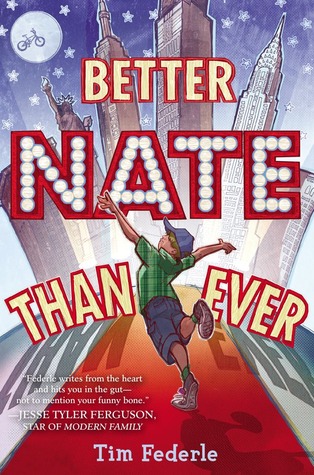
It’s time for another Bookanista recommendation: Tim Federle’s hilarious and heartfelt Better Nate Than Ever.

Here’s the summary from Goodreads:

13414183Nate Foster has big dreams. His whole life, he’s wanted to star in a Broadway show. (Heck, he’d settle for *seeing* a Broadway show.) But how is Nate supposed to make his dreams come true when he’s stuck in Jankburg, Pennsylvania, where no one (except his best pal Libby) appreciates a good show tune? With Libby’s help, Nate plans a daring overnight escape to New York. There’s an open casting call for E.T.: The Musical, and Nate knows this could be the difference between small-town blues and big-time stardom.

You know how movie ads used to always feature an announcer saying, “Blah Blah Movie will make you stand up and cheer!” Well, Better Nate Than Ever will make you stand up and cheer. (So since you’ll be standing up and cheering, watch what you’re wearing while you read because it might also make you pee your pants. It’s that funny.) Nate is a protagonist you will root for, cringe with, and want to give a big huge hug. Mostly, you’ll wish you could be there in the scenes with him, to watch him be in the world with such hope and wonder. I love how exuberant the boy on the cover is; I love it even more after reading the book and knowing that Nate encounters some real hardships.

Reading this felt like a bit of bibliotherapy for me. I do a lot of my reading on the subway, and as much as I love New York, sometimes it seems one or more of the following: stressful, crowded, dirty, stinky, rude, exhausting, expensive, noisy. Et cetera. While reading, I felt like I could vicariously fall in love with my new hometown all over again, seeing it through Nate’s eyes. Or at least laugh hysterically at the uber realistic details Tim Federle weaves into the story–and bonus, that makes the people next to you on the crosstown bus scooch away and give you a little more space! Win win.

See what my fellow Bookanistas are recommending today:
 

The Problem with Stars

Confession: I’ve resisted joining Goodreads for the longest time. While I’ve long used–and appreciated!–the site to get information about books and read non-editorial reviews, I didn’t want an author account.* The main reason why? The stars. 

To clarify, I don’t think there is anything wrong with rating and reviewing books, and I certainly don’t judge anyone who does. Ratings can be a very useful tool for readers, and even authors! My problem is that I personally can’t figure out a way to use the stars that seems fair to me as a reader as well as fair to the rest of the people on the site.
The thing is, the star rating system (on Goodreads, Amazon, or any site that encourages quantitative ratings of books) doesn’t use a standardized metric. Each individual on the site has to come up with their own, unique rating system–and they might vary their method depending on the book, their mood, or changing tastes. That’s how you get one-star reviews of Jane Eyre and five-star reviews of critically-trashed commercial fiction. Some people rate based on personal opinion. Some based on quality of the writing, despite whether or not they enjoyed the work. Others rate on whether their expectations (based on category, genre, etc.) were met. (To be honest, that’s probably the method that makes the most sense to me. Otherwise I would feel weird about giving five stars to both a lauded classic and a beach read, you know? They weren’t intended to be the same type of work or reading experience–and that’s okay.)
If a reader wants an apple but gets an orange, is that 1 star for not being the desired apple? Or however many stars the book deserves as an orange? Because that orange book was never intended to satisfy apple cravings, anyway.

(Now I want some fruit.)

A solution, of course, is writing a review that explains the rationale behind the stars. But some people–like me–don’t want to review. And for that reason, I’m shelving books aplenty on Goodreads, but I won’t be rating them. It doesn’t seem fair to assign a quantitative measure without explaining how I got there. I really value Goodreads as a reference and a community, and I’m excited to become more active there, but for now I think I’ll keep a blank slate of stars.
Are you on Goodreads? How do you approach reviews and stars?

*But now I have one. Let’s be friends!

On Patience and the Bottle in my Fridge

Many moons ago, someone gave me a bottle of decent champagne. I think it might have been leftover from a holiday party. I didn’t have an occasion to open it at the time, and I’m not generally fabulous enough to pop a bottle of bubbly for no reason. It was around the time I first went on submission for the first time ever, so I thought, “I’ll save this for the day I accept an offer for my book.” (Which I realize now is a slightly obnoxious but not uncommon thought pattern for newbies on sub.)

The champagne sat in the way-back of my fridge. And it sat. It sat for so long that I started Googling things like, “Does champagne go bad?”
Oh, there were times when it looked like I’d be opening it. I’d open the fridge door to get some carrots and smile at the bottle. Soon, soon. Maybe I’d pull the champagne flutes out of storage and rinse off the dust, you know, just in case.
HUBRIS ALERT. The occasion to take out the bottle never materialized, despite coming painfully close to fruition.

On some days, that green bottle mocked me from its perch on the shelf. I stuck the Brita pitcher in front of it to hide it. My husband found it one day. “Did you know that there is a bottle of champagne in the fridge? What’s that doing there?”
“Nothing.” Saving that champagne was a stupid idea, I thought. The bottle is going to sit in there forever. I’ll be packing it up for every move. Each December, I’ll debate yanking it out for New Year’s just to get rid of it. If I ever have children and then someday they have to move me into a nursing home, they’ll find it and ask, “Mom, why is there a bottle of champagne from 20– in here?” But I kept it in there anyway. Because part of me always believed that I would, in fact, have the occasion to open it someday.

That bottle became a random symbol of determination, of the hope and optimism a writer needs when working on another round of revision or a fresh first draft. Maybe someday people will read these words I’m writing. If I really REALLY work hard, if I’m patient, and if I’m just a little bit lucky. When that happens, I will celebrate. I will pop that champagne, finally.

You probably know where I’m going with this. That heavy, green, EMPTY champagne bottle went out with last week’s recyclables. The cork is sitting on my desk. Dreams do come true, hard work is rewarded. Patience pays off, and so does optimism. And this is why it’s good to never give up.

The Hippocratic Oath for Revisions

This week I’m returning to a sh!tty first draft from a long hiatus. It’s been so long and the draft is so raw that I don’t know whether to call this an extension of drafting, rewriting, or revising. It’ll probably be all three.

I get nervous when I start a revision, for a lot of reasons but mostly because I’m afraid of making the MS worse. The phrase that pops in my head as I work is a famous one from the Hippocratic Oath, “First, do no harm.” [Oh, wait. Apparently that line was never explicitly stated in the actual oath itself.] Anyway, my manuscript is like a sick patient and I’m standing at the operating table, scalpel in hand, not totally sure what to do. All I know is that I want the story to get better, and I better not hurt it.

It makes me wish that there was a writers’ Hippocratic Oath for Revisions; something to guide the process or the way I should approach the daunting work. So I wrote one.

The Hippocratic Oath for Revisions/Rewrites
—Adapted from the Modern Hippocratic Oath, which was written in 1964 by Louis Lasagna, Academic Dean of the School of Medicine at Tufts University. The Modern Hippocratic Oath is used in many medical schools today. Full text of the oath: The Hippocratic Oath Today

I swear to fulfill, to the best of my ability and judgment, this covenant:

I will respect the hard work I already have done on this manuscript, and I will gladly view this revision (including its successes and missteps) as a learning experience for the manuscripts to follow.

I will apply, for the benefit of the sick story, all measures [that] are required to make it well, avoiding those twin traps of overcorrection and “therapeutic nihilism,” or the idea that fixing what is wrong with the story is impossible.

I will remember that there is science to writing as well as art. I will seek out craft advice as well as my own creativity. I will remember that showing warmth, sympathy, and understanding to myself, the author, may outweigh draconian work schedules or self-criticism. (Conversely, I will commit to regular and focused work on the task at hand.)

I will not be ashamed to say “I know not,” nor will I fail to call in my beta readers, CPs, and writing friends when the skills of another are needed for a manuscript’s recovery.

When making changes, I will remember this: First, do no harm. I will prevent creating new problems whenever I can, for prevention is preferable to cure. Most especially must I tread with care in matters of cutting and adding. If it is given me to save a book, all thanks. But it may also be within my power to trunk a book; this awesome responsibility must be faced with great humbleness and awareness of my own strengths and weaknesses. 

I will remember that I remain a member of the writing community, with special obligations to all my fellow writers as well as readers. I will respect the great storytelling tradition as I work. I will think of words and meaning, not sales figures and markets.

If I do not violate this oath, may I enjoy life and art, respected while I live and remembered with affection thereafter. May I always act so as to preserve the finest traditions of my calling and may I long experience the joy of writing. Even in the midst of revisions.

So, writer friends: What have I left out of the oath? Or what should be cut?

Revision Trick: Synopsize Me

I know, I know. Synopses are devilish. But hear me out on this one.
I always start revisions by reading through my WIP, fighting the urge to make line edits the whole time. (If I let myself start making edits, I would never get through the read. So if something is really important, I jot it down on my ongoing revisions list, which is usually the length of Ulysses by the time I start revising.) But this time, to help keep my hands busy while I read, I synopsized my WIP. The urge to line-edit disappeared.

I didn’t mind writing the synopsis while doing my first read-through, mainly because I (apparently) forgot what happened in roughly 40% of my WIP. So I wasn’t slogging through dialogue I had memorized and scenes seared into my brain–the story was fresh, and I found it interesting to summarize each chapter after I read it. There’s a reason why teachers make kids summarize/retell as techniques for monitoring comprehension. It works. I remember all of my WIP after synopsizing it.

Summarizing/synopsizing helped me see the places in the WIP where eighty billion things happen at once (I’m looking at you, Chapter 14) and those where nothing happens for a really, really long time and it’s boring. I can clearly see where the pacing needs work. My synopsis is also helping me figure out where I might place the scenes I want to add and where certain subplots disappear/appear. I’m the type of person who needs to be able to see the big picture a lot while revising. My synopsis will now be my map.

For each round of revision I start on this WIP, I’m going to start by updating my synopsis with a read-through. It’ll both refresh my memory and show me which parts saw the most/least work. The best part? By the time I’m done with revisions once and for all*, I’ll have a synopsis ready should I ever need it.

*”once and for all” = for now, because I am a compulsive reviser

Have you ever used a synopsis to help with the early rounds of revision, writer friends? What are your revision tricks? Spill!

Archives