talking about writing

YA Research: Interview with an Urban, Public-School Teacher

Back in the day, I went to a large public high school in a small city. I’ve realized that most of the YA and MG books I (personally) read are set in suburbs or small towns. It made me wonder: what’s it like to be a teen in a larger city these days? I turned to my sister, who is a super-awesome, National Board-certified teacher and basically my hero. She agreed to answer some questions about the school she teaches at and her students. It’s a cool perspective on life at a large, diverse urban public school.

Tell us a little about the high school you teach at.
My school is a large, urban (some would say inner city) high schools with 3600+ students. Our school is diverse, like our city, with its majority of students Latino but also with many African-American, Chinese-American, Polish-American, Pakistani-American and Palestinian-American students.

What are your students’ biggest school-related concerns?
My students are stressed! They often feel like jugglers–they are learning to balance seven classes, which in junior and senior year are all college level, with other extracurricular clubs and sports and their service learning obligations. Most of my students have at least five hours of homework nightly, but many do not get home until 6 or 7 p.m. because they stay after school for activities like Physics study groups, History essay writing workshops, soccer practice, lifeguarding training, stained glass art club, or school musical rehearsal. Plus my students are under a lot of pressure from our school to improve their ACT scores!

What are some outside-of-school problems, issues, or concerns your students face?
My students live with a range of issues outside of school. Since our school is located six miles southwest of downtown Chicago, the surrounding neighborhoods have many socioeconomic issues common to inner cities. If you walk around our school’s neighborhood you see some boarded up buildings, both homes and businesses. You see tagging. You do not see many public parks, and our local library cut its hours recently. My students live among the problems of their environment: family money problems, parents working two jobs, high rates of unemployment and homelessness, gang violence and related drug and alcohol abuse. Yet my students balance living with these problems as well.  They help their parents when take their little sisters and brothers to school, pick them up afterward and help them complete their homework. They walk around in small groups to stay safe, and scorn drug and alcohol usage. They even volunteer with our school’s urban ecology club to pick up trash in the neighborhood, and have been writing letters to local government officials to try to get more resources for our school’s neighborhood like green space, lengthened library hours and a community health clinic.

Is bullying a problem at your school?
I think that our school is somewhat of an urban oasis from bullying due to its large size. We are large enough that there is no one popular group– instead, there are the basketball players and cheer squad, the soccer team, the musical theater group, the dancers (we have a classical ballet program), the goths, the emo kids, the Key Club, the manga lovers, GLBT Pride and numerous study groups. Among freshmen, there is a tendency to verbally bully left over from elementary school, but teachers do NOT allow this behavior to continue. A big part of our Social Studies curriculum is to deter bullying by teaching social understanding and civic competence. This helps greatly– students learn that there is tremendous diversity among our school population in terms of ethnicity, religion and sexuality. Furthermore, they learn that discriminating against each other due to differences is NOT acceptable.

What do your students get excited about, in terms of academic subjects/topics, the news, music, pop culture, etc.?
My students pay some attention to the news and pop culture via the internet, but their passions really come alive for music. Some of them participate in after school dance programs where they learn traditional ethnic dances of Mexico, West Africa and Poland. Others just dance to their iPods at home:) In terms of academic subjects, in History class students really connect to learning about the Age of Exploration, the Age of Imperialism and the Holocaust. I think that a universal part of being in high school across cultures is that kids are defining themselves, and asking questions related to “who I am going to be?” History class lets them time travel and ask related questions about their values and identities: “If I were alive in 1519 when Cortes arrived in Mexico would I resist or collaborate with his conquistadors? In 1933 Germany, would I support Hitler or join youth movements against him?”

What things aren’t your students interested in?
Their homework?!? Seriously though, one misconception about urban students is that they are disengaged from their schoolwork as well as from communities. Based on my experiences, that is NOT true. My 60 graduating seniors last year earned $640,000 in college scholarships. If I asked them this question, they would respond: “drugs? reality television? doing chores at home?”

What is prom like at your high school?
Since our school is in a large city, every year our senior student committee chooses a downtown ballroom for prom. Students tend to choose a different venue each year, to personalize their graduating class’s experience. They choose a theme, like “Red Carpet Nights,” that ties together with the decorations, catering and favors at the hosting hotel. Prom begins with a formal dinner for all to enjoy, followed by dancing with a live DJ until midnight.   Professional photographers take formal and informal pictures of students throughout the night. As for attending students, some come as couples but many others come as groups of friends. Their fashion sense is the best part of prom night– many fashion forward girls design their own dresses and have them custom made by local seamstresses. Some make their dates get custom tailored vests and ties for their suits to match their dresses! We even have a prom fashion show to fundraise for the main event to see their gowns early. Also at prom, it is common for our goth and emo kids to show up wearing Chuck Taylor All-Stars along with vintage dresses. Prom is awesome!

Do your students have time to read for fun? If so, what do they enjoy reading?
My students LOVE reading. They are especially captivated by manga, as well as fantasy and science fiction novels for young adult readers… especially the Hunger Games trilogy this year. They recently competed in a school wide trivia contest about Hunger Games, complete with parachutes. Since then the Katniss braid has definitely increased in popularity.

What makes you most proud of your students? What surprises you most about teens today? 

My answers to these last two questions are interconnected. My students’ strength, resilience and ability to be down-to-earth both surprise me and make me very proud. My students are often stereotyped differently, but in reality they are devoted to their families, friends and educations. They are facing numerous problems, both in their neighborhoods and the larger society, but are striving to overcome them. They continue to impress me daily with their diligence, perseverance and optimism about being able to make their lives and our world better.

I told you about someone else!

The Hippocratic Oath for Revisions

This week I’m returning to a sh!tty first draft from a long hiatus. It’s been so long and the draft is so raw that I don’t know whether to call this an extension of drafting, rewriting, or revising. It’ll probably be all three.

I get nervous when I start a revision, for a lot of reasons but mostly because I’m afraid of making the MS worse. The phrase that pops in my head as I work is a famous one from the Hippocratic Oath, “First, do no harm.” [Oh, wait. Apparently that line was never explicitly stated in the actual oath itself.] Anyway, my manuscript is like a sick patient and I’m standing at the operating table, scalpel in hand, not totally sure what to do. All I know is that I want the story to get better, and I better not hurt it.

It makes me wish that there was a writers’ Hippocratic Oath for Revisions; something to guide the process or the way I should approach the daunting work. So I wrote one.

The Hippocratic Oath for Revisions/Rewrites
—Adapted from the Modern Hippocratic Oath, which was written in 1964 by Louis Lasagna, Academic Dean of the School of Medicine at Tufts University. The Modern Hippocratic Oath is used in many medical schools today. Full text of the oath: The Hippocratic Oath Today

I swear to fulfill, to the best of my ability and judgment, this covenant:

I will respect the hard work I already have done on this manuscript, and I will gladly view this revision (including its successes and missteps) as a learning experience for the manuscripts to follow.

I will apply, for the benefit of the sick story, all measures [that] are required to make it well, avoiding those twin traps of overcorrection and “therapeutic nihilism,” or the idea that fixing what is wrong with the story is impossible.

I will remember that there is science to writing as well as art. I will seek out craft advice as well as my own creativity. I will remember that showing warmth, sympathy, and understanding to myself, the author, may outweigh draconian work schedules or self-criticism. (Conversely, I will commit to regular and focused work on the task at hand.)

I will not be ashamed to say “I know not,” nor will I fail to call in my beta readers, CPs, and writing friends when the skills of another are needed for a manuscript’s recovery.

When making changes, I will remember this: First, do no harm. I will prevent creating new problems whenever I can, for prevention is preferable to cure. Most especially must I tread with care in matters of cutting and adding. If it is given me to save a book, all thanks. But it may also be within my power to trunk a book; this awesome responsibility must be faced with great humbleness and awareness of my own strengths and weaknesses. 

I will remember that I remain a member of the writing community, with special obligations to all my fellow writers as well as readers. I will respect the great storytelling tradition as I work. I will think of words and meaning, not sales figures and markets.

If I do not violate this oath, may I enjoy life and art, respected while I live and remembered with affection thereafter. May I always act so as to preserve the finest traditions of my calling and may I long experience the joy of writing. Even in the midst of revisions.

So, writer friends: What have I left out of the oath? Or what should be cut?

Revision Trick: Synopsize Me

I know, I know. Synopses are devilish. But hear me out on this one.
I always start revisions by reading through my WIP, fighting the urge to make line edits the whole time. (If I let myself start making edits, I would never get through the read. So if something is really important, I jot it down on my ongoing revisions list, which is usually the length of Ulysses by the time I start revising.) But this time, to help keep my hands busy while I read, I synopsized my WIP. The urge to line-edit disappeared.

I didn’t mind writing the synopsis while doing my first read-through, mainly because I (apparently) forgot what happened in roughly 40% of my WIP. So I wasn’t slogging through dialogue I had memorized and scenes seared into my brain–the story was fresh, and I found it interesting to summarize each chapter after I read it. There’s a reason why teachers make kids summarize/retell as techniques for monitoring comprehension. It works. I remember all of my WIP after synopsizing it.

Summarizing/synopsizing helped me see the places in the WIP where eighty billion things happen at once (I’m looking at you, Chapter 14) and those where nothing happens for a really, really long time and it’s boring. I can clearly see where the pacing needs work. My synopsis is also helping me figure out where I might place the scenes I want to add and where certain subplots disappear/appear. I’m the type of person who needs to be able to see the big picture a lot while revising. My synopsis will now be my map.

For each round of revision I start on this WIP, I’m going to start by updating my synopsis with a read-through. It’ll both refresh my memory and show me which parts saw the most/least work. The best part? By the time I’m done with revisions once and for all*, I’ll have a synopsis ready should I ever need it.

*”once and for all” = for now, because I am a compulsive reviser

Have you ever used a synopsis to help with the early rounds of revision, writer friends? What are your revision tricks? Spill!

I love this poem.

A Poet’s Poem
Brenda Shaughnessy

If it takes me all day,
I will get the word freshened out of this poem.

I put it in the first line, then moved it to the second,
and now it won’t come out.

It’s stuck. I’m so frustrated,
so I went out to my little porch all covered in snow

and watched the icicles drip, as I smoked
a cigarette.

Finally I reached up and broke a big, clear spike
off the roof with my bare hand.

And used it to write a word in the snow.
I wrote the word snow.

I can’t stand myself.

I think it applies to novelists, too.
Thanks to Megan for a) knowing I would love it b) emailing it to me.

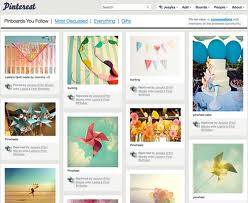
Pinterest for Writers

I stumbled into joining Pinterest lately–my friend invited me and I signed up, but had no idea what I was making an account for. Then other friends started “following” me on Pinterest and I still didn’t have a clue what it was, but figured it was time to figure it out. So, being a lazy person in the 21st century, I posted a status on Facebook: Hey guys, what is this Pinterest thing and why should I be using it?
Turns out Pinterest is a collection of virtual pin boards, social-networked. The official explanation:

What is Pinterest?
Think of Pinterest as a virtual pinboard — a place where you can create collections of things you love and “follow” collections created by people with great taste.
People use Pinterest to collect and share all sorts of things — wedding inspiration, favorite T-shirts, DJ equipment. You name it, people are pinning it.
We know you have great taste in something. Our mission is to make Pinterest the best place for you to share your taste with the world.
It feels kind of like fantasy football but for stuff. Sure, it’s inspiring, but looking at other people’s boards starts to make me feel a little tight-chested, like I am never going to have enough disposable income/time to make my home/wardrobe/travel plans/food look even 1/8 as good as the stuff on Pinterest. I turn away from the screen and see my haphazard, design-aesthetic-lacking furniture and the jar of Old El Paso in my fridge and stretched-out cardigans from Old Navy and feel like a wee bit of a failure at life.
But–I’ve found one awesome way to use Pinterest for my writing. I’ve always tried to make character collages to get a sense of the gestalt of my characters. Handmade, IRL collages are not the easiest to put together; you need a lot of magazines, glue sticks, and time. It’s also easier said than done to find the right images for your characters/settings/whatever you’re making the collage for. Not so with a virtual pin board. I can create a new board for a character or scene, then run all over the Internet snagging related images. Maybe I find a house that looks like the spooky one a character is renting. Then maybe I find an image of the food she’s cooking, the dress she’s wearing, the musician whose album she’s playing when the ghost first appears. When I sit down to write the scene later, all my inspiration is right there on Pinterest if I need it.
I’m not sure yet how much I’ll use Pinterest as a writing tool–for one thing, pin boards are public and I like to write with the door closed. It’s a cool option to have, though.

Chunk It.

I adopted a nifty, new (to me) process while revising my WIP: chunking.

chunking • \chung’ king\ v. 1 the processing of splitting an overwhelming MS into “chunks,” or parts, in order to revise the whole by parts.

I didn’t set out to chunk my MS on purpose, but it was already split into distinct parts because it has two POVs. I wrote the two POVs separately, mainly because I don’t like switching back and forth while writing and also I wanted each narrative to stand on its own. I am about to finally stitch the two together, once I go through POV #1 one more time with my little red pencil. 
Because the story alternates between those two POVs, each narrative already has distinct breaks. This meant that when I started revising I had 2 narratives, one with 4 parts and one with 5. 
(All these numbers are confusing me already. TOO MUCH MATH FOR WRITING! And I even like math.)
Anyway, I’ve been revising each part on its own, in preparation for revising the story as a whole. And you know what? Chunking was super-helpful! Focusing on sections of the story on a micro-level was so manageable. I had none of those, OMG, what am I going to do with the end of this book?!? moments because I was just focusing on the chunk at hand.
Of course, chunking can only be part of the revision process, otherwise the larger story arc will likely not work. That’s what I’m about to start working on, smoothing over the story on the macro level [bites nails]. Knowing that my chunks are pretty solid [that phrase . . . makes me think of barf. Sorry.] makes me feel refreshingly confident going in, though.

You are not like Milli Vanilli.

How many of you writers have found yourself thinking any of the following:

  • I only got an agent/got published/won an award because of luck, or because I wrote the right thing at the right time.
  • So what if I wrote that book, now I have to write another. And it has to be better.
  • I can’t believe nobody has picked up on the typos in Chapter 7 or that terrible passage I didn’t cut in Chapter 19. Eventually, someone will and then they’ll all see what a hack I am.
  • I didn’t deserve to get so much praise for that book/attract the attention of some agents/get published. What I do isn’t half as good as writers X, Y, and Z. It’s not even a thimbleful as good.
  • If [insert your favorite writer here] had written what I wrote, maybe then it would be decent.
  • I’m not a *real* writer.

Persistent self-doubting thoughts might be fleeting bouts of insecurity, or they might be a sign that you’re suffering from impostor syndrome. Which is a real thing:

Do You Have the Imposter Syndrome?
Imposter Syndrome–Feeling Like a Fraud
[Note: Apparently “impostor” and “imposter” are both accepted spellings? Merriam-Webster was a little confusing on this one.]
I should know. One of the speakers at my grad-school orientation gave lecture about the dangers of the impostor syndrome in academia. Sitting in the audience, after a couple of stress-filled days in which my internal mantra was What the hell am I doing here?!?!, I had an impostor-syndrome epiphany: You mean I’m not the only person who feels this way? Who thinks that eventually everyone else in my department will figure out that I’m the village idiot who slipped through the admissions cracks? Apparently, I was not.

It’s easy to slip into impostor thought patterns as a writer. It’s easy to overlook the laudable and successful things you’ve done (no matter what stage of the publishing process you’re at) and write them off as flukes, luck, frauds. If you ever receive a compliment for your writing and your response begins with but/actually/no, I really just/or some other modifier instead of “Why, thank you. That’s so wonderful to hear”–congrats, you’re acting like someone who thinks s/he is an impostor.

Being humble is good. Being realistic is good. Knowing your strengths and weaknesses is good. Being open to criticism that makes you grow and evolve and improve is good. Thinking that you are an impostor is bad. It’s not productive, just stressful.

If you write, you are a writer. If you’ve experienced success, you most likely deserved it. Ignore impostor-y thoughts and focus instead on enjoying the writing process, which always involves occasional mistakes, usually followed by growth and improvement.

Girl you know it’s true: you are not like Milli Vanilli.

Revision Trick: Wordle

Before I started inputting my hard-copy edits Saturday, I decided to make a Wordle of my MS. (Yes, I was procrastinating.) Copying my entire 70K MS to the clipboard and pasting it into the Wordle maker almost killed my computer, which was probably EXTREMELY STUPID to do, especially because I didn’t save the file or anything beforehand. But I lucked out, my geriatric MacBook regained its footing, and I got this cool Wordle out of it:

Neat, huh? Also–educational. Notice which words are the largest? Alex, like, Emma, really, and just. Two of those refer to characters, so I would expect them to be used a lot. One of them can be used as several parts of speech–like is verb, modifier, and verbal tic/filler–but still shouldn’t be that prevalent. The MS is not a courtroom drama, so I doubt just was ever used as anything but a modifier. And really–really? I guess I really need to cut down on how really often I use really. Really.
Obviously, after several rounds of revision I’ve varied my word choice and cleaned up the prose and a lot of the interesting words I’ve used aren’t going to show up in a Wordle made from 70,000 words. Even if I only use really and like every three pages, they’d still be big. That doesn’t mean, though, that I shouldn’t try to cut their use as much as possible. Making the Wordle was a giant reminder that I need to watch for repetition and be mindful of what I can cut so the story is told more eloquently and efficiently.
Ready to revise your WIP? Try just making a Wordle, and help yourself see which words you really need to snip.

People are going to turn around and look up

I was at the Happiest Place on Earth on Monday, and it occurred to me that Disneyland is sort of live-action fiction. You wander through all of these very detailed, distinctive fictive neighborhoods, waiting in line to get on rides that simulate space or fairytale lands or somewhere under the sea (cue Sebastian), etc. The whole park is actually built above ground level–you’re walking over a series of tunnels that “cast members” use to travel to and from the different lands (in order to preserve the magic element of the park). I think the word for it is verisimilitude: everything has the appearance of truth but isn’t really true. It can feel a little like walking through a book.

But even if you immerse yourself totally in the experience, it’s easy to get to reminded that what’s going on around you isn’t real. All you have to do is turn around (or look up at the rafters) and you see carefully concealed emergency exits, strings of lights, security cameras, animatronic ghosts and pirates and animals repeating the same canned movements. Most rides depend on the rider keeping his or her butt in the seat (and hands safely inside the ride at all times!), facing forward, never turning to look back behind. Of course, people do turn around and look up.

Maybe there’s a lesson for writers in this: you need to assume that your reader is going to turn around, look back, glance upwards. Disneyland does a remarkably good job of creating an alternate world (except for It’s a Small World, which kind of looks like it was set up in an empty hotel ballroom, with track lighting on the ceiling and exposed staples and exit signs everywhere) but if you look closely, you can always see little signs to remind you that this is all Made Up. When you’re writing, you need to try to make sure that you conceal those types of signals. Sometimes that’s making sure you don’t miss continuity errors (“Jean” becomes “Joan;” a 14-year-old neighbor celebrates her 12th birthday, etc.); sometimes it’s making sure that your protagonist’s actions and emotions make sense based on how you have established him/her so far and where his/her arc is going. Make sure your readers aren’t asking (unintended) questions along the lines of, How come I can still see Captain Jack Sparrow inside the Pirate’s cave while directly in front of me he’s locked up in a jail cell? Such as, Why is Rachel suddenly attending the dance that she spent the last 30 pages trashing? And at all costs, avoid slowing down the pacing to a stall (the equivalent of the dreaded “The ride will be moving shortly” announcement); you don’t want your readers shifting in their seats, waiting for something to happen.

I am clearly not “waiting for
 something to happen” here.

Not all works are striving for verisimilitude with the real world, but whatever environment you are creating should be as seamless as possible. You want your reader to believe in its authenticity. Whether you’re building the world of a suburban high school or the kingdom of the Mer-people, remember that your readers will be looking in all directions.

Running and Writing

I never do my best writing at my desk. I don’t even do it at the computer.

I write best when I’m running.
I get my best ideas while running. (Running outside, at least. When I’m running on the treadmill I can’t think anything other than God, I hate this. Can I stop yet? Please? This is torture.) It’s while I’m doing laps around the reservoir or traversing the park loop that all of the things I can’t seem to figure out about my characters or the plot or the setting get solved. Whatever the knotty issue is, it perfectly untangles while I’m running. I’ve always loved how running can be meditative and that it has a unique ability to help you organize your thoughts. It has always helped me get creative, but it wasn’t until I started writing that I realized what an incredible tool running is for a writer.

My only problem is that by the time I get back home and take a shower, I have often forgotten certain truths uncovered while on the path.
Solving that is tricky. Obviously, I don’t run while holding a laptop or a notepad. I suppose I could get a voice recorder and tape any important thoughts that come to me while running, but really–that’s kind of insane. (Sorry if anyone does actually narrate to a Dictaphone while jogging–no offense.) I think it would make running less productive, too. I highly suspect that part of the reason why running helps me think so well is that while I’m doing it, I can’t be checking my phone, responding to an email, glancing at the TV, hearing my neighbors play Grand Theft Auto, getting interrupted by the oven timer, etc. While running your body is consumed (i.e. distracted) by the activity, so as long as you don’t run into a tree (which I’ve done) or trip and fall (also have done) or get crapped on by a bird (yup) or realize that you have to pee really badly and there are no bathrooms for 3 miles (uh huh) or pull a tendon in your foot (also yup), your mind is free to wander and ponder.

So I try to jot down any epiphanies when I come in the door, and if something still gets forgotten, I know that I can always go for a run the next day. Feet permitting.

How a Book Used to Be Made

The Westing Game was my favorite books from fifth grade to–well, it’s still a favorite. If you haven’t read it, please go find a copy because it’s an amazing read.

I was perusing the [Cooperative Children’s Book Center] CCBC’s site today and unexpectedly discovered that they have an online archive of the manuscript of The Westing Game. Author Ellen Raskin donated her manuscript materials and provided audio and written commentary in 1978, around the time the book was published by Dutton. Her goal was to inspire those who used CCBC’s services, because she “often remarked during her career that she wished she had known ‘where children’s books come from’ while she was a young UW-Madison art student.”

I think this archive is really, really cool even if you don’t adore The Westing Game. The process Raskin describes for book production is very, very different from how it’s done today, so it’s a kick to see how publishing used to work. There are scores of her handwritten notes, outlines and planning (such as her notes on potential titles), research materials (such as a letter about Wisconsin Judges), marked-up drafts, and even her book cover designs. If you have any interest in manuscript history/the history of publishing, check it out! If you don’t care about book production, you still might be inspired by some of her methods for the writing process.

Archives