I can sum up Teen Author Carnival 2012 in one word: fantastic.
So fantastic, in fact, that while I was enjoying listening to all the wonderful authors speak, I neglected to take notes about the panels. Doh.
I did take some pictures, though:
The Keeping it Realistic panel
Authors Lauren E. Morrill and Siobhan Vivian
The Where Have You Been All My Life? panel
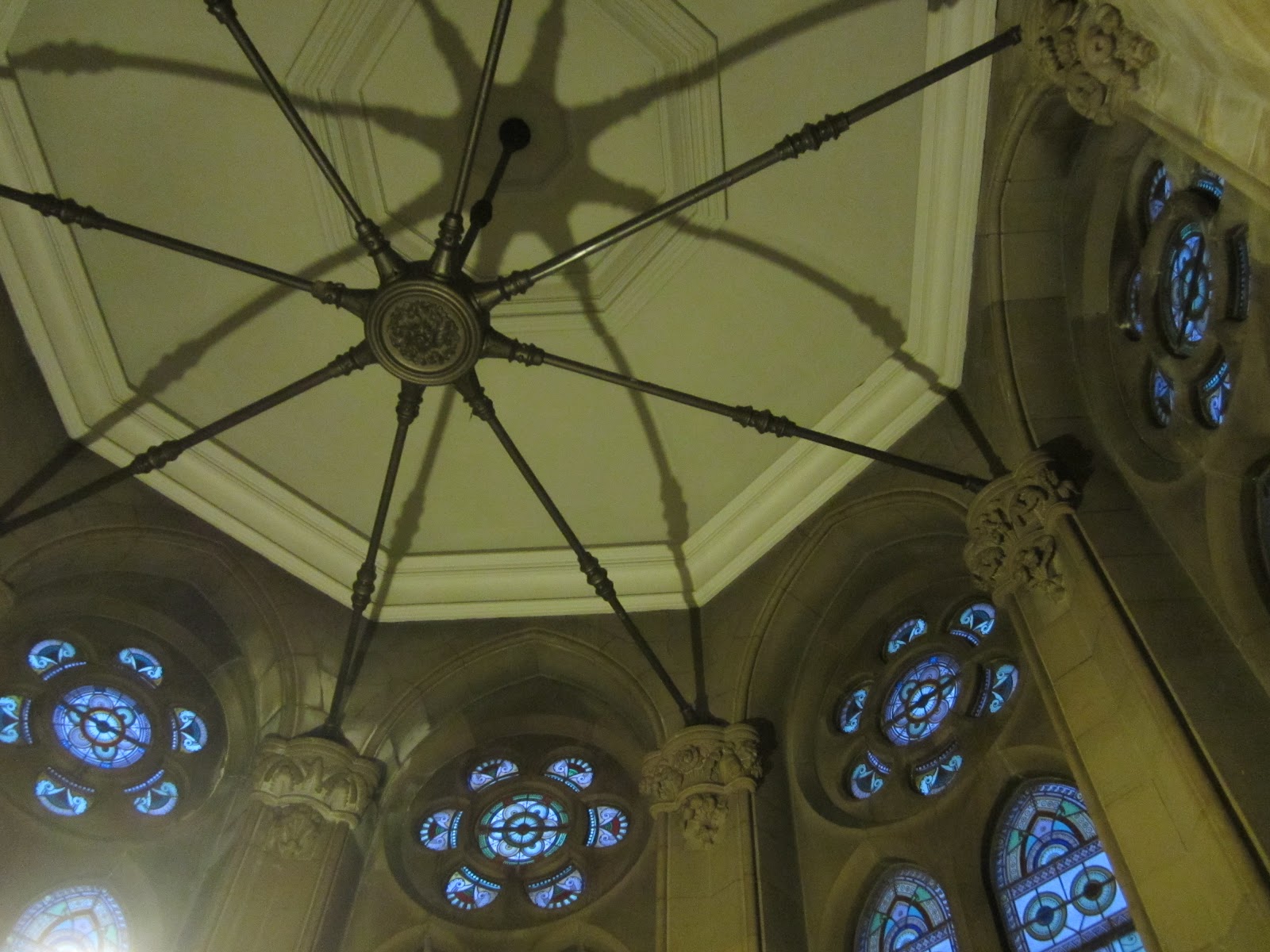
Such a gorgeous library
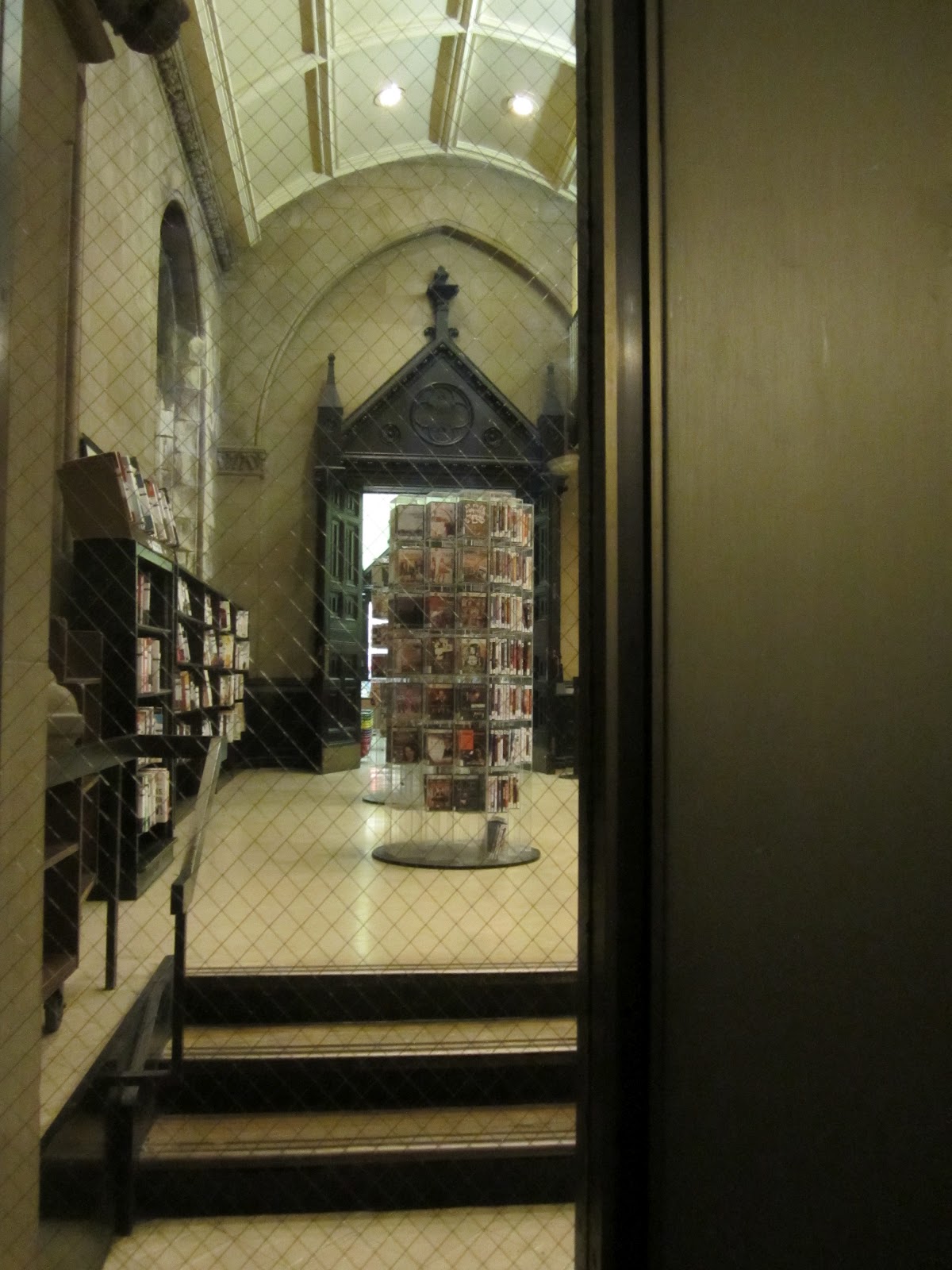
More gorgeous library (through a door, hence the crappy photo)
I also got to meet up in person
with some super-cool writer peeps, like Ghenet, Gina, and Elodie! And
learned an important lesson about why it is finally time for me to get a
smartphone (I still use a slide-out qwerty phone without internet):
because I missed out on meeting quite a few other writer friends because
I had no access to Twitter until I got home. Sad face. It’s time, so
I’ll head to the Apple store this weekend, and into the 21st century!
Have you been to any BEA week events this week?
Back in the day, I went to a large public high school in a small city. I’ve realized that most of the YA and MG books I (personally) read are set in suburbs or small towns. It made me wonder: what’s it like to be a teen in a larger city these days? I turned to my sister, who is a super-awesome, National Board-certified teacher and basically my hero. She agreed to answer some questions about the school she teaches at and her students. It’s a cool perspective on life at a large, diverse urban public school.
Tell us a little about the high school you teach at.
My school is a large, urban (some would say inner city) high schools with 3600+ students. Our school is diverse, like our city, with its majority of students Latino but also with many African-American, Chinese-American, Polish-American, Pakistani-American and Palestinian-American students.
What are your students’ biggest school-related concerns?
My students are stressed! They often feel like jugglers–they are learning to balance seven classes, which in junior and senior year are all college level, with other extracurricular clubs and sports and their service learning obligations. Most of my students have at least five hours of homework nightly, but many do not get home until 6 or 7 p.m. because they stay after school for activities like Physics study groups, History essay writing workshops, soccer practice, lifeguarding training, stained glass art club, or school musical rehearsal. Plus my students are under a lot of pressure from our school to improve their ACT scores!
What are some outside-of-school problems, issues, or concerns your students face?
My students live with a range of issues outside of school. Since our school is located six miles southwest of downtown Chicago, the surrounding neighborhoods have many socioeconomic issues common to inner cities. If you walk around our school’s neighborhood you see some boarded up buildings, both homes and businesses. You see tagging. You do not see many public parks, and our local library cut its hours recently. My students live among the problems of their environment: family money problems, parents working two jobs, high rates of unemployment and homelessness, gang violence and related drug and alcohol abuse. Yet my students balance living with these problems as well. They help their parents when take their little sisters and brothers to school, pick them up afterward and help them complete their homework. They walk around in small groups to stay safe, and scorn drug and alcohol usage. They even volunteer with our school’s urban ecology club to pick up trash in the neighborhood, and have been writing letters to local government officials to try to get more resources for our school’s neighborhood like green space, lengthened library hours and a community health clinic.
Is bullying a problem at your school?
I think that our school is somewhat of an urban oasis from bullying due to its large size. We are large enough that there is no one popular group– instead, there are the basketball players and cheer squad, the soccer team, the musical theater group, the dancers (we have a classical ballet program), the goths, the emo kids, the Key Club, the manga lovers, GLBT Pride and numerous study groups. Among freshmen, there is a tendency to verbally bully left over from elementary school, but teachers do NOT allow this behavior to continue. A big part of our Social Studies curriculum is to deter bullying by teaching social understanding and civic competence. This helps greatly– students learn that there is tremendous diversity among our school population in terms of ethnicity, religion and sexuality. Furthermore, they learn that discriminating against each other due to differences is NOT acceptable.
What do your students get excited about, in terms of academic subjects/topics, the news, music, pop culture, etc.?
My students pay some attention to the news and pop culture via the internet, but their passions really come alive for music. Some of them participate in after school dance programs where they learn traditional ethnic dances of Mexico, West Africa and Poland. Others just dance to their iPods at home:) In terms of academic subjects, in History class students really connect to learning about the Age of Exploration, the Age of Imperialism and the Holocaust. I think that a universal part of being in high school across cultures is that kids are defining themselves, and asking questions related to “who I am going to be?” History class lets them time travel and ask related questions about their values and identities: “If I were alive in 1519 when Cortes arrived in Mexico would I resist or collaborate with his conquistadors? In 1933 Germany, would I support Hitler or join youth movements against him?”
What things aren’t your students interested in?
Their homework?!? Seriously though, one misconception about urban students is that they are disengaged from their schoolwork as well as from communities. Based on my experiences, that is NOT true. My 60 graduating seniors last year earned $640,000 in college scholarships. If I asked them this question, they would respond: “drugs? reality television? doing chores at home?”
What is prom like at your high school?
Since our school is in a large city, every year our senior student committee chooses a downtown ballroom for prom. Students tend to choose a different venue each year, to personalize their graduating class’s experience. They choose a theme, like “Red Carpet Nights,” that ties together with the decorations, catering and favors at the hosting hotel. Prom begins with a formal dinner for all to enjoy, followed by dancing with a live DJ until midnight. Professional photographers take formal and informal pictures of students throughout the night. As for attending students, some come as couples but many others come as groups of friends. Their fashion sense is the best part of prom night– many fashion forward girls design their own dresses and have them custom made by local seamstresses. Some make their dates get custom tailored vests and ties for their suits to match their dresses! We even have a prom fashion show to fundraise for the main event to see their gowns early. Also at prom, it is common for our goth and emo kids to show up wearing Chuck Taylor All-Stars along with vintage dresses. Prom is awesome!
Do your students have time to read for fun? If so, what do they enjoy reading?
My students LOVE reading. They are especially captivated by manga, as well as fantasy and science fiction novels for young adult readers… especially the Hunger Games trilogy this year. They recently competed in a school wide trivia contest about Hunger Games, complete with parachutes. Since then the Katniss braid has definitely increased in popularity.
What makes you most proud of your students? What surprises you most about teens today?
My answers to these last two questions are interconnected. My students’ strength, resilience and ability to be down-to-earth both surprise me and make me very proud. My students are often stereotyped differently, but in reality they are devoted to their families, friends and educations. They are facing numerous problems, both in their neighborhoods and the larger society, but are striving to overcome them. They continue to impress me daily with their diligence, perseverance and optimism about being able to make their lives and our world better.
That’s my new motto, at least when it comes to weeknights. I used to try to do a lot in my off-work hours: hit the gym, cook dinner, whip up a blogpost for the next day, catch up on other social media, read, call my fam, and get in some writing time. Sometimes I’d go really crazy and try to add cleaning, laundry, or (gasp) some kind of socializing in the mix.
Shocker: I ended up half-assing a whole lot of stuff.
My new philosophy? One thing well.*
On weeknights, aside from the non-negotiables (some kind of exercise or activity to destress; healthy eating, whether I prepare it or someone else does) and quality time with fiance/catching up with friends and family, I get to do one task. And I will try to do it well.
If it’s a night on which I want to revise two chapters, I’m not going to try to write a post, too. If I need to vacuum my insanely dusty apartment,** then maybe I’m not going to finish a read-through. I know what my priorities are, and it’s surprisingly easier than I thought to balance one-thing-per-night in accordance to them. Maybe I’ll clean less if I’m trying to finish a draft. Maybe I’ll blog more once a project is off with beta readers. Etc.
And you know what is kind of great? Going to sleep knowing that maybe you didn’t get everything done, but you sure whole-assed what you did.
*Slightly different context, but here’s a nice post from Zen Habits on Do One Thing Well **Seriously, why is dust not a form of energy; because if it were, I would be so very filthy rich. Science, please get on that.
This week I’m returning to a sh!tty first draft from a long hiatus. It’s been so long and the draft is so raw that I don’t know whether to call this an extension of drafting, rewriting, or revising. It’ll probably be all three.
I get nervous when I start a revision, for a lot of reasons but mostly because I’m afraid of making the MS worse. The phrase that pops in my head as I work is a famous one from the Hippocratic Oath, “First, do no harm.” [Oh, wait. Apparently that line was never explicitly stated in the actual oath itself.] Anyway, my manuscript is like a sick patient and I’m standing at the operating table, scalpel in hand, not totally sure what to do. All I know is that I want the story to get better, and I better not hurt it.
It makes me wish that there was a writers’ Hippocratic Oath for Revisions; something to guide the process or the way I should approach the daunting work. So I wrote one.
The Hippocratic Oath for Revisions/Rewrites —Adapted from the Modern Hippocratic Oath, which was written in 1964 by Louis Lasagna, Academic Dean of the School of Medicine at Tufts University. The Modern Hippocratic Oath is used in many medical schools today. Full text of the oath: The Hippocratic Oath Today I swear to fulfill, to the best of my ability and judgment, this covenant: I will respect the hard work I already have done on this manuscript, and I will gladly view this revision (including its successes and missteps) as a learning experience for the manuscripts to follow. I will apply, for the benefit of the sick story, all measures [that] are required to make it well, avoiding those twin traps of overcorrection and “therapeutic nihilism,” or the idea that fixing what is wrong with the story is impossible. I will remember that there is science to writing as well as art. I will seek out craft advice as well as my own creativity. I will remember that showing warmth, sympathy, and understanding to myself, the author, may outweigh draconian work schedules or self-criticism. (Conversely, I will commit to regular and focused work on the task at hand.) I will not be ashamed to say “I know not,” nor will I fail to call in my beta readers, CPs, and writing friends when the skills of another are needed for a manuscript’s recovery. When making changes, I will remember this: First, do no harm. I will prevent creating new problems whenever I can, for prevention is preferable to cure. Most especially must I tread with care in matters of cutting and adding. If it is given me to save a book, all thanks. But it may also be within my power to trunk a book; this awesome responsibility must be faced with great humbleness and awareness of my own strengths and weaknesses. I will remember that I remain a member of the writing community, with special obligations to all my fellow writers as well as readers. I will respect the great storytelling tradition as I work. I will think of words and meaning, not sales figures and markets. If I do not violate this oath, may I enjoy life and art, respected while I live and remembered with affection thereafter. May I always act so as to preserve the finest traditions of my calling and may I long experience the joy of writing. Even in the midst of revisions.
So, writer friends: What have I left out of the oath? Or what should be cut?